“Mississippi never stopped burning and the South never stopped fighting the Civil War. And any assumption otherwise is to Black Mississippians and African Americans peril.” – William A. Foster, IV
In a river town, the families who fished the water had no seat on the council that ruled the river. When one of their sons was accused of a crime, the council’s magistrate tried him again and again, each time sending the fisherman’s neighbors home from the jury. When a higher authority finally freed him, the council paid a sum fixed by its own ledger and called the matter closed. The families understood what the council would not say: the wrong was never about one magistrate. It was about who owned the council.
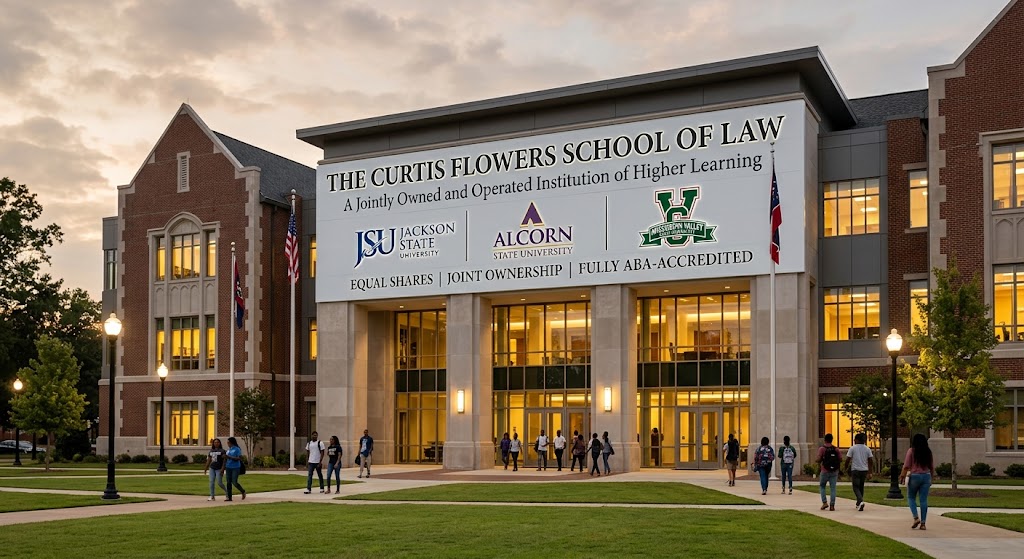
Curtis Flowers died on October 7, 2026, at his home in Winona, Mississippi. He was 56. No cause of death has been announced, but the shape of his life is not in dispute. Nearly 23 of his 56 years were spent in Mississippi’s custody, much of it on death row, for a crime the state could never legitimately prove he committed. He lived barely six years free of the charges. His story is usually told as an individual tragedy, made possible by one rogue prosecutor and corrected by the Supreme Court. That reading is comfortable and wrong. The Flowers case was the output of an institutional arrangement in which Black Mississippians, nearly two-fifths of the state, control almost none of the institutions that train lawyers, staff prosecutors’ offices, seat judges, or govern their own public universities. A wrong produced by institutions cannot be repaired with a check. HBCU Politics argues that the minimum restitution Mississippi owes is institutional: a law school named for Curtis Flowers and jointly owned by the state’s three public HBCUs, a permanent $10 million annual appropriation dedicated to it, and a separate HBCU Institutions of Higher Learning system with its own board.
The record is settled. Flowers was tried six times between 1997 and 2010 for the 1996 killing of four people at Tardy Furniture in Winona, every time by District Attorney Doug Evans. Three convictions were overturned for prosecutorial misconduct, two trials ended in mistrials, and the sixth produced another death sentence. In 2019 the U.S. Supreme Court reversed it, noting that across the six trials the state struck 41 of the 42 Black prospective jurors it could have struck, a “relentless, determined effort to rid the jury of black individuals.” The two trials with multiple Black jurors both deadlocked. It took journalists, not the state, to expose the rest: American Public Media’s “In the Dark” found that a jailhouse informant had recanted and surfaced an alternative suspect never disclosed to the defense. Mississippi did not drop the charges until September 2020.
Then the state settled its account: $500,000, paid at $50,000 a year for ten years, the statutory maximum. Mississippi took 23 years and paid for ten, because its own law had capped liability in advance. Evans resigned in 2023 after more than 30 years in office, without comparable consequence. Individual compensation and individual departures leave every structure that produced the case exactly where it was.
The timing invites a comparison with Texas. In June 1998, while Flowers’s first conviction was on appeal, three white men in Jasper, Texas, two of them known white supremacists, dragged James Byrd Jr. to his death behind a pickup truck. The dates matter. Opponents of African American institutional empowerment routinely argue that the injuries Black Americans cite belong to a distant past. Flowers and Byrd answer that argument directly. Both unfolded in the late 1990s, within the adult lives of most legislators now setting HBCU budgets, and the case against Flowers was not abandoned until 2020. The absence of Black-controlled legal institutions is not a legacy problem that time will resolve. It is a present condition. The two states’ responses also differ. As Gulf News noted, Byrd’s murder led Texas to pass the James Byrd Jr. Hate Crimes Act in 2001, and Washington followed with a federal act in 2009. Texas wrote Byrd’s name into statute; Mississippi wrote Flowers a capped check. Yet a statute is enforced by prosecutors, judges, and legislatures the affected community does not control. What Black Texans hold, and Black Mississippians do not, is a law school: the Thurgood Marshall School of Law at Texas Southern University. A name honors; an institution compounds.
The gap is old. In 1930, Mississippi had six Black lawyers. Its only public law school, at the University of Mississippi, admitted no Black students until 1963, and the Magnolia Bar Association records that Black Mississippians who wanted to study law before 1955 had to leave the state or teach themselves. About 38 percent of Mississippians are Black, yet only four Black justices have ever sat on the state Supreme Court, never more than one at a time.
Mississippi has already declined one chance to close that gap. The Ayers litigation, filed in 1975 over the underfunding of Jackson State, Alcorn State, and Mississippi Valley State, ended in a 2002 settlement worth $503 million over 17 years. Civil rights attorney Alvin Chambliss pressed for a law school at Jackson State; none was created. The settlement established a $70 million public endowment, fully funded only in fiscal 2019, and a $35 million private endowment the IHL board was to raise; by 2022 it had raised about $1 million. Even the public money came with conditions: each HBCU was denied control of its share until it enrolled at least 10 percent other-race students for three consecutive years. Alcorn qualified in 2005, Jackson State later, and Mississippi Valley State, as of the Associated Press’s reporting, never.
The condition reads differently against the state’s own data. In fall 2025, the IHL’s enrollment fact book shows Black students at 11.2 percent of enrollment at the University of Mississippi, including its medical center, 17.1 percent at Mississippi State, and 27.1 percent at Southern Miss, in a state roughly 38 percent Black. At Ole Miss, the Black share has fallen from 13.4 percent in 2015 even as total enrollment grew by nearly a fifth. The burden of integration was placed on the institutions holding the least capital. Its premise deserves scrutiny too. A public HBCU that remains more than 90 percent African American is not a remedy unfinished; it is an institution concentrating its resources on the population it was built to serve and on the gaps the rest of the system left open. Concentration is how institutions build strength. A remedy whose private half went roughly 97 percent unfunded, and whose public half was released only on the governing board’s terms, has failed as a remedy.
Governance is the deeper problem. The three HBCUs answer to the Board of Trustees of State Institutions of Higher Learning, whose twelve members are appointed from the state’s three Supreme Court districts, the same districts plaintiffs challenged in federal court for allegedly diluting Black voting strength. In 2009, Governor Haley Barbour proposed folding Alcorn and Valley into Jackson State. In 2024, Senate Bill 2726 would have required the board to select three universities for closure. An institution whose governing body can be directed to choose it for closure is not governed for its advancement. It is governed as a liability.
A separate board helps, but it is not sufficient. Louisiana’s Southern University System, Texas Southern, and Morgan State in Maryland each have their own boards, and each board is appointed by a governor. Texas Southern showed the consequence in 2020, when its regents abruptly terminated President Austin Lane and one regent reportedly asserted the board could fire anyone down to the janitor. Walter Kimbrough, then president of Dillard University, wrote that “The entire board must be replaced. Immediately.” and urged supporters to press Governor Greg Abbott. The remedy ran back through the governor’s office, because that is where the board’s power originates. Separation solves jurisdiction; it does not solve appointment.
John Henrik Clarke said he believed profoundly in Black colleges because people rise and fall within the context of these institutions, while warning that some had become stillborn. Mississippi’s HBCUs have been permitted to exist but denied the professional schools, endowments, and self-governance that would let them reach full strength.
The proposal has three parts.
First, the Curtis Flowers School of Law should be an ABA-accredited law school jointly owned in equal shares by Jackson State, Alcorn State, and Mississippi Valley State. Joint ownership has precedent: North Carolina A&T, an HBCU, and the University of North Carolina at Greensboro, a predominantly white institution, jointly operate the Joint School of Nanoscience and Nanoengineering. The school would hold a single accreditation, with a common first year and concentrations at each campus. Jackson State, near the legislature and the courts, would anchor public law and appellate practice. Alcorn, the nation’s oldest public Black land-grant university, would anchor agricultural and heirs’ property law, where Black landowners continue to lose wealth. Valley, the HBCU closest to Winona, would anchor criminal justice and rural practice. Tougaloo College and Rust College could serve as partners or alternative hosts, subject to the conditions the state constitution places on funding private institutions, and Coahoma Community College and Hinds Community College’s Utica campus could provide early pathways into the profession. The school’s signature clinic should do what the state failed to do: publish peremptory-strike data from every circuit court district, so the next Doug Evans is identified in years, not decades.
Second, the restitution should be a permanent statutory appropriation of $10 million a year, indexed to inflation. That is two hundred times the annual payment Flowers received; at a 5 percent payout, it is equivalent to a $200 million endowment, nearly three times the Ayers public endowment. In a general fund measured in billions, the cost is marginal. The money should flow into an independent endowment corporation, so that neither the legislature, nor a governor, nor a board a governor appoints can redirect it. Restitution that must be re-won every session is not restitution.
Third, the three universities should leave the IHL for a parallel system of their own: an HBCU Institutions of Higher Learning, with a joint board, its own commissioner, and a system office. Louisiana already runs several public university systems side by side. Because the IHL board is a constitutional body, the change requires an amendment, which is the opportunity to design the new board correctly. Gubernatorial appointees should hold a minority of seats; the rest should be elected by the three national alumni associations, the faculties, and bodies such as the Magnolia Bar Association, serving long staggered terms and removable only for cause. Pennsylvania State University already seats alumni-elected trustees. The HBCU IHL would govern the law school, coordinate programs rather than letting the campuses compete, and negotiate with the state as a single bloc.
The law school would also retain capital and concentrate talent. Today, a Black Mississippian seeking an HBCU legal education must leave for Baton Rouge, Houston, Durham, Orlando, or Washington. HBCU law schools, about 3 percent of the nation’s law schools, award roughly a quarter of Black law degrees. A school at home keeps the tuition, the graduates, and their professional networks in Mississippi.
The pattern of trading ownership for access is older than Ayers. As HBCU Money argued on the fiftieth anniversary of James Meredith’s 1962 entry into Ole Miss, the struggle secured one man’s admission to an institution Black Mississippi did not control, while Alcorn, Jackson State, and Valley remained unequal. In 2012, the publication counted roughly $876 million in combined endowments at Ole Miss, Mississippi State, and Southern Miss against about $23 million at the three HBCUs, a 38-to-1 gap. As of June 2020, federal data reported by The Plug put the HBCUs’ combined endowments at $69 million, about one-tenth of Ole Miss’s alone. A current figure is harder to establish because none of the three reports to NACUBO, and capital that is not measured is difficult to manage or defend. Mississippi State alone reported about $1 billion in fiscal 2025, a mark only one HBCU, Howard, has reached. Brandeis, Notre Dame, Brigham Young, and the nation’s tribal colleges exist because their communities chose to build institutions they govern. Access has never been a substitute for ownership.
The danger now is substitution. Jackson State, rather than receiving a law school, entered a law program partnership with the University of Mississippi School of Law. HBCU Money argued that such agreements let predominantly white institutions select HBCUs’ strongest undergraduates, and that Ole Miss would never accept the reverse arrangement. Black Mississippians are nearly 40 percent of the state but, by that analysis, under 9 percent of its active lawyers; a pipeline into another community’s institution will not change that ratio. Partnerships, scholarships, and study commissions have their uses, but none is restitution, and none should be accepted in exchange for it. The test for any offer is simple: does it give Mississippi’s HBCUs ownership of the institution, control of the capital, and governance over both? If not, it is appeasement.
None of this waits entirely on Jackson. The national alumni associations of the three universities, legally independent of them, coordinated a joint letter against the 2024 closure bill. That coordination can become a permanent compact with the Magnolia Bar Association, the Mississippi Center for Justice, and the six existing HBCU law schools to fund feasibility studies, draft the enabling legislation, and build interim clinics.
The current political climate makes adoption unlikely soon. That is not a reason to withdraw the claim. Restitution is defined not by what a debtor is willing to pay but by what was taken. The Ayers case took 27 years to settle. Curtis Flowers spent 23 years waiting for the state’s institutions to admit what its own transcripts showed, and he died at 56, six years after they did. A law school bearing his name, funded in perpetuity and governed by a system answerable to Mississippi’s HBCUs rather than to the governor’s office, is not the full measure of what is owed to his memory or to the generations of Black Mississippians who passed through the same courts. It is the floor.
Disclaimer: This article was assisted by ClaudeAI.

