“It is unlikely that we are seeing the end of the superpower era because the world has always had them throughout history, but we maybe witnessing the rise of smaller and middle countries think about their risk allocation to ANY superpower going forward more prudently. Think of it as the geopolitical version of not putting all of your eggs in one basket.” – William A. Foster, IV
A man kept a running account with his cousin for thirty years. Every few seasons the cousin’s household changed its mind — sometimes generous, sometimes hostile, always certain, always different from the last time. The man never stopped speaking to his cousin. He never publicly announced a break. He simply started keeping less money in that account, opening others elsewhere, and building a second set of relationships that did not depend on his cousin’s mood swinging back in his favor. By the time anyone noticed, the account was still open. It just wasn’t where the money lived anymore.
That is the posture the world has now adopted toward the United States; not rupture, but quiet re-weighting, and it is happening simultaneously across capital markets, alliances, and multilateral institutions on nearly every continent. In the span of a few weeks in 2026 alone, four unrelated stories from four unrelated domains converged on a single diagnosis: the institutions that used to price American commitments as durable are now pricing them as conditional on the next election cycle, and they are restructuring accordingly. Norway’s $2.3 trillion sovereign wealth fund, the largest pool of investment capital on earth, formally proposed cutting the government-bond share of its benchmark index from 70 percent to 50 percent, a reduction that would strip roughly $80 billion from its approximately $215 billion position in U.S. Treasuries, with the freed capital redirected into corporate debt and mortgage-backed securities rather than sovereign paper. Canada’s prime minister, leading a G7 economy whose trade with the United States has anchored its postwar prosperity, is exploring a newly invented “associate member” status with the European Union integrating Canadian energy, AI, defense, and critical-minerals supply chains into Brussels’ regulatory perimeter as a hedge against Washington’s tariff unpredictability. A peer-reviewed analysis in Tropical Medicine and Health documented the collapse of American-led global health infrastructure following the suspension of foreign development aid, projecting millions of additional malaria, tuberculosis, and HIV cases as programs built over two decades were terminated within months. And in Kyiv, strategists concluded that a year spent courting personal favor with the American president could not substitute for a durable security relationship, forcing Ukraine to treat U.S. backing as conditional rather than guaranteed and to accelerate its own production capacity, battlefield innovation, and coordination with European partners instead.
The pattern extends well beyond these four cases, and that breadth is the point. NATO’s own European members are confronting the same recalculation at the alliance’s core: heading into this year’s summit in Ankara, the Pentagon advanced plans to withdraw roughly a third of the F-16 and F-15 aircraft assigned to NATO, halve its assigned strategic bombers, reduce aerial tankers, and pull a missile-launching submarine and an aircraft carrier from the alliance’s shared pool of capabilities on top of roughly five thousand troops already being withdrawn from Germany. European officials had hoped for a structured, mutually agreed transition; the working assessment inside the alliance now is that no such roadmap will provide a reliable planning basis, and that Europe must accelerate an independent defense-industrial base regardless of whether Washington coordinates the timeline. Central banks worldwide have spent the past several years adding gold to their reserves at a pace unseen in decades, diversifying away from concentration in dollar-denominated assets in the same spirit Norway is now diversifying away from Treasuries specifically. Germany, Poland, and the Baltic states have pushed defense spending toward 3.5 percent of GDP and beyond, converting decades of outsourced deterrence into domestic investment, even as European states farther from the immediate threat have moved more slowly. Gulf sovereign wealth funds have broadened their own investment mandates well beyond U.S. equities and debt. Regional trade architecture from the African Continental Free Trade Area to Mercosur has accelerated efforts to deepen commerce that does not route through Washington’s approval. None of this is centrally coordinated. It does not need to be. It is what happens when dozens of independent capital allocators and governments run the same risk calculation, on the same underlying variable, and reach compatible conclusions within the same few years.
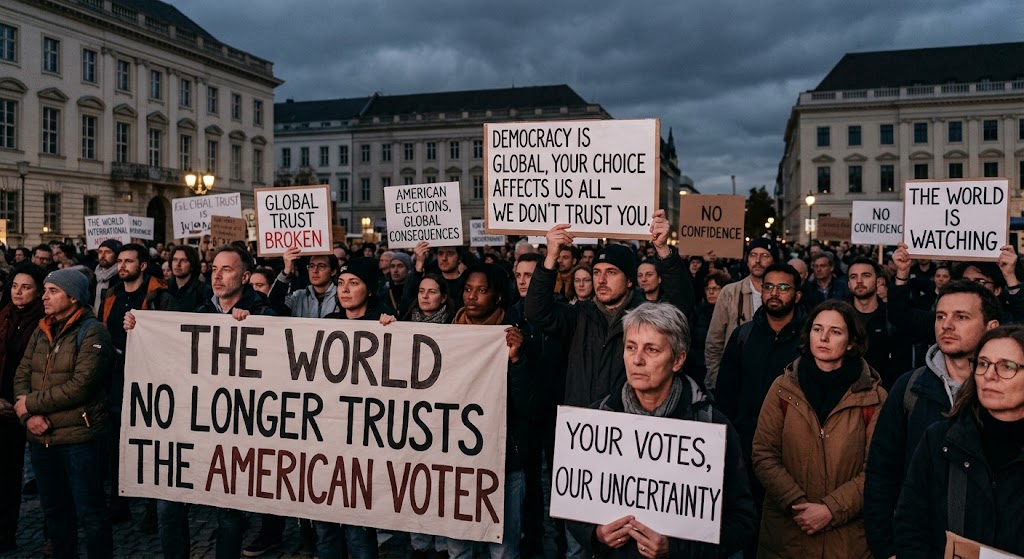
None of these institutions; a sovereign fund, a G7 government, a global health research collaborative, a wartime government, a military alliance renegotiating its own command structure, a continent’s worth of central banks doubts American power. What they no longer trust is the American voter’s consistency in directing that power. This is the structural fact HBCU Politics exists to name plainly: the world has begun treating the U.S. electorate as a variable too volatile to underwrite long-duration commitments, and it is repricing every relationship that depends on American policy continuity accordingly. That repricing is not a partisan judgment about any single administration. It is a statistical one, made by people whose job is to manage risk for decades rather than news cycles.
The postwar architecture that made American commitments investable rested on an assumption few examined until it broke: that U.S. foreign and economic policy, however contested domestically, would not reverse itself wholesale with each change of administration. The United States built its global-health leadership over decades, most notably through PEPFAR, and became the largest single funder of programs addressing malaria, HIV, tuberculosis, and polio worldwide. That leadership was underwritten by the premise that funding commitments made under one president would survive a change in party. Instead, roughly 80 percent of USAID’s global health projects — around 615 of 770 — were forced to close following the aid suspension, and researchers now project the reduction could produce millions of additional infections and hundreds of thousands of additional deaths across malaria, tuberculosis, and HIV programs by 2030. Recipient governments built their public health systems on the assumption of American continuity. That assumption was wrong, and the institutions that trusted it are now paying the arrears.
Sovereign capital learned the same lesson from a different angle. Norges Bank Investment Management, which manages Norway’s sovereign wealth fund, has proposed cutting its weighting to government bonds within its benchmark bond index from 70 percent to 50 percent, with U.S. Treasuries — its largest single holding — absorbing the biggest reduction, a shift that would remove nearly $80 billion from the fund’s roughly $215 billion Treasury position. Treasuries have functioned as the risk-free anchor of the global financial system since Bretton Woods precisely because a Treasury bond was treated as immune to the volatility of American domestic politics, a claim on the full faith and credit of a government, not a bet on which party controls that government in any given decade. The fund held more than $615 billion in fixed-income assets as of June, and the proposal reflects a judgment that a 50 percent government allocation still covers liquidity needs even in periods of market turbulence, while freeing capital to pursue better returns elsewhere. A sovereign fund does not make an $80 billion allocation decision on sentiment. It makes it on a multi-decade read of where risk is concentrated, and it has concluded that risk is now concentrated in exactly the asset class that was supposed to be risk-free.
Canada’s maneuver is the geopolitical mirror of Norway’s balance-sheet maneuver. Prime Minister Mark Carney is exploring whether Canada could become an “associate member” of the European Union, a status that does not currently exist but that EU officials are reportedly open to creating, with talks covering free movement of goods, services and workers in strategic sectors including energy, AI, defense and critical minerals, effectively extending the EU’s economic border to include Canadian supply chains. Canada is not abandoning its relationship with Washington; like the man in the parable, it is not closing the account. It is building a second one, insulated from the terms of the first. A G7 founding member, geographically and historically the most dependent ally the United States has, is now negotiating institutional shelter from its own largest trading partner.
Ukraine’s own strategic reckoning illustrates the same lesson from the ally’s side of the table. After more than a year spent trying to secure continuity in Washington’s backing, Kyiv’s leadership concluded that persuasion alone could not restore a security relationship that had already been weakened by shifts in U.S. domestic politics. That recognition forced a change in wartime strategy: rather than building its defense around the hope that renewed goodwill in Washington would restore full-scale backing, Ukraine began treating American support as uncertain and expanded its own weapons production, battlefield innovation, and coordination with European partners capable of sustaining that support independent of any single U.S. administration’s disposition. Ukraine did not sever its relationship with its largest patron. It stopped making that patron’s continuity the precondition for its own survival, building leverage and operational autonomy instead of waiting on reassurance. A state fighting for its existence reached the same structural conclusion a sovereign wealth fund, a G7 government, a military alliance, and a continent’s worth of central banks reached for very different reasons: dependency on a single, electorally volatile patron is not a strategy, it is an exposure, and the only defensible response is to reduce it.
That same fracture has a domestic echo, though “echo” undersells it. What the world is now discovering about American reliability, African American institutions have always known and not as a distant historical grievance, but as a live, structural feature of operating inside this particular democracy. The difference is that for most of that history, the unreliability stayed contained: a domestic condition, absorbed by institutions built specifically to survive it, invisible to a Norwegian pension fund or a Canadian prime minister because it never had to be their problem. What the past decade did was remove the containment. The same volatility that Black institutions had always priced into their own planning stopped respecting the boundary between domestic and foreign policy, between how Washington treats its own citizens and how it treats its treaty allies and trading partners. It was always there, underneath the postwar assumption of continuity that the rest of the world built its own commitments on top of. Now that assumption has cracked widely enough that everyone else can see what was always structurally true.
The lesson the world is drawing from that fracture is straightforward: treat no commitment tied to the current political mood as durable, and build the capacity to not need it to be. That lesson is playing out as proportional de-risking rather than rupture. Norway is not liquidating its Treasury holdings; it is reducing them from a dominant position to a still-substantial one, and redirecting the difference toward assets less exposed to a single government’s fiscal and political cycle. Canada is not abandoning its relationship with Washington; it is building a second set of commitments insulated from the first. NATO’s European members are not withdrawing from the alliance; they are building the independent capability to make American troop levels and aircraft commitments a supplement to their own defense rather than its foundation. Ukraine is not severing its relationship with its largest patron; it is refusing to make that patron’s continuity the precondition for its own survival. In every case, the pattern is the same: reduce dependency on a single counterparty whose commitments reset with each election, without treating that counterparty as an adversary.
That is the shape institutional strategy takes when trust in political consistency erodes but trust in the underlying relationship does not. It does not require hostility toward the United States, and none of the actors described here have expressed any. It requires an honest accounting of what an American election can now do to a decade-old plan, and a refusal to build anything essential on top of an assumption that no longer holds.
The deeper significance of this shift extends beyond any single balance sheet or alliance structure. For the first time in the postwar era, the institutions best positioned to judge counterparty risk at scale; sovereign funds, G7 governments, military alliances, central banks have reached a collective verdict on the reliability of the world’s dominant power, and that verdict is now being priced into decisions worth trillions of dollars. The world stopped trusting the American voter to behave consistently, and it is restructuring itself around that judgment in real time. Whatever comes next in American politics, the repricing already underway will not simply reverse because a single election goes a different way, the institutions doing the repricing are planning on multi-decade horizons, and one election’s worth of reassurance does not undo a decade’s worth of demonstrated volatility. The world is not waiting to find out if the next cycle is different. It is building the capacity not to need it to be.
Disclaimer: This article was assisted by ClaudeAI.

