“Powerful people never have to prove anything to anyone. And by extension, powerful people never apologize to powerless people for the actions they take in order to remain in power.” — Dr. John Henrik Clarke
In the closing weeks of a Senate primary, two campaigns file for the same seat. The first campaign has a super PAC, a political committee legally permitted to raise and spend unlimited money on a candidate’s behalf, so long as it does not coordinate directly with the campaign, seeded eighteen months earlier. It has a compliance attorney on retainer, a media buyer who has placed ads in that market for a decade, and a bundler network, meaning a group of individual donors organized to combine their contributions into a single, much larger sum, that can produce $2 million on a Tuesday afternoon. The second campaign has enthusiasm, a strong candidate, and a church network that can turn out four thousand voters on Election Day. The first campaign wins the primary before the second campaign’s yard signs are printed. Neither campaign lied about its intentions. Neither campaign broke any rules. One had built the infrastructure of political finance years in advance. The other had built a movement. Only one of those things converts into a seat in Congress.
This is the story of African American politics in the current era, and it is not a story about villains. It is a story about infrastructure; the absence of it, the cost of that absence, and the decades of institutional habit that produced it. HBCU Politics is introducing Political Finance as a standing category because the gap it covers is not a footnote to African American political strategy. It is the central structural weakness in it, and it will not close through moral argument, voter registration drives, or turnout messaging alone. It closes through capital, and capital requires institutions built specifically to organize, retain, and deploy it.
Some framing before the argument: “African America” here refers to Black institutions and communities in the United States as a collective political and economic actor, not any single organization. “Institutions” means the durable, purpose-built organizations; banks, universities, law firms, standing political committees that outlast any one person or election cycle and accumulate capacity over time. The premise that governs this analysis is the same one that governs every institutional question African America faces: communities rise or fall based on the strength of their institutions, not the brilliance of their individuals or the righteousness of their cause. Political power in the United States is, at its mechanical core, a capital allocation problem. Candidates are recruited, vetted, and funded years before a general election. Primaries, the intra-party contests that determine who appears on the November ballot, actually decide who represents most congressional districts, because most districts are drawn to be safely Democratic or safely Republican. In a safe district, the primary winner wins the seat automatically; the general election is a formality. That means the donors who show up early, in the primary, exert far more influence per dollar than the voters who show up in November.
The Financial Times reported this dynamic plainly in its recent midterms coverage: in the 2025–2026 election cycle, pro-Republican megadonors dramatically outpaced their Democratic counterparts in early, concentrated giving. George Soros, a billionaire investor and the most prominent Democratic megadonor, gave $102 million, but he stood largely alone among comparably sized Democratic donors. Arrayed against him was a coordinated bloc, not a collection of isolated donors: venture capitalists Marc Andreessen and Ben Horowitz at $96.2 million, billionaire businessman Jeff Yass at $91.3 million, Elon Musk at $90.5 million, the Republican Senate super PAC One Nation at $70.7 million, business couple Richard and Elizabeth Uihlein at $70 million, and casino magnate Miriam Adelson at $67.6 million. Maga Inc, the political committee receiving much of this capital, has amassed $400.7 million and, notably, has spent very little of it. The money is sitting, positioned, waiting to be deployed with precision into the specific primaries where it will do the most damage or the most good. Stanford political scientist Adam Bonica’s observation on this pattern is instructive: donors have recognized that early spending in primaries is more efficient than spending in general elections, because in safely Democratic or safely Republican districts, the primary is the election.
African America has no comparable vehicle. Not one at $400 million, not one at $40 million, not one that functions as a coordinated, standing, pre-positioned pool of capital ready to be deployed into primaries eighteen months before anyone else notices the race exists. What exists instead is a pattern that has held for sixty years: mobilize voters, trust the vote, and treat fundraising as an emergency response mechanism rather than permanent infrastructure. This is not a criticism of the people who built that model. Voter mobilization after the Voting Rights Act of 1965 was existential and it worked, turnout is the reason Black political representation exists at all in the numbers it does today. But turnout mobilization and capital infrastructure are two different institutional functions. One gets people to the polls. The other decides who is on the ballot when they arrive. Only the first has been built at scale.
The historical roots of this asymmetry are structural, not accidental. The civil rights era produced an extraordinary set of institutions optimized for a specific problem: legal enforcement and voter access. The NAACP Legal Defense Fund, the Southern Christian Leadership Conference, and the voter registration apparatus built by the Student Nonviolent Coordinating Committee and its successors were built to fight for and secure the franchise itself. They were not built to fund candidates, and they were never intended to. That was the correct institutional response to the problem of 1965. It is not the correct institutional response to the problem of 2026, where the franchise is legally secured but the capital markets that determine who exercises power within that franchise are dominated by donor classes with no comparable African American counterpart. Meanwhile, other American political constituencies have spent the decades since building exactly this kind of donor infrastructure: Jewish American political giving networks; the cryptocurrency industry’s Fairshake political action committee, which reshaped multiple 2024 congressional primaries with concentrated early spending; and the network of donor-advised funds and political committees aligned with industrialists Charles and the late David Koch, which has functioned for fifty years as a standing capital allocation machine for a specific ideological agenda. These are not spontaneous formations. They are the product of deliberate, decades-long institution-building: law firms that specialize in campaign finance compliance, bundler networks cultivated and maintained across election cycles, think tanks that produce the policy infrastructure candidates run on, and standing political committees that do not dissolve after a single cycle.
The structural challenge is fourfold, and each piece compounds the others. First, capital retention fails at the fundraising stage itself, meaning the money that is raised does not stay inside the African American institutional ecosystem long enough to build capacity there. When African American political money is raised, it disproportionately flows through mainstream white-owned consulting firms, ad-buying agencies, and law firms, not because Black-owned equivalents don’t exist, but because no institutional mechanism routes political spending toward them by default. A political committee that spends $10 million on media buys through a Black-owned media strategy firm builds that firm’s capacity for the next cycle; more staff, more equipment, more relationships, more retained earnings that can be reinvested. A committee that spends the same $10 million through a firm with no connection to the ecosystem builds nothing that outlasts the election; the money is spent once and gone. Second, talent concentration in political finance has never been deliberately built. Political finance requires a specific specialized workforce: compliance attorneys who understand federal election law, treasurers who can manage a political committee’s books under legal scrutiny, and bundlers who cultivate donor relationships across years. There is no standing pipeline for this talent comparable to what conservative donor networks run through affiliated law schools and training programs. HBCUs produce extraordinary talent in corporate law, tax law, and finance, but campaign finance and election law as a specialized track is nearly absent from that pipeline, which means the compliance and fundraising infrastructure of Black political campaigns is disproportionately staffed by people trained outside the ecosystem, if it is staffed with specialists at all. Third, strategic coordination is nearly nonexistent. What Black political giving does exist is fragmented across dozens of small political action committees, none of which pool resources, none of which coordinate timing, and none of which function as the kind of unified vehicle that One Nation or Maga Inc represent for their donor base. Fragmentation means that even meaningful aggregate giving produces minimal strategic effect, because it never concentrates enough capital in a single primary at a single moment to change an outcome.
A fourth gap sits underneath the first three: African America has no standing mechanism for identifying and developing political talent before that talent is already a candidate. Political finance in its most sophisticated form is not reactive — it does not wait for a strong candidate to emerge and then compete to fund them alongside every other donor who noticed the same thing. It identifies talent early and invests in it deliberately, the same way a venture investor takes an equity stake in a company before the market has priced it, precisely because getting in early is what makes the eventual return possible. A city council member with real potential, a state legislator with the discipline to build a policy record, a first-time candidate for county commission who understands the ecosystem’s economic priorities; these are the equivalent of a Series A investment, made years before anyone else is paying attention, at the local and state levels where most political careers actually begin and where the cost of entry is lowest. This requires more than money. It requires training programs that teach compliance, fundraising, and coalition management before a first campaign, and it requires a standing expectation, communicated early and directly, that any candidate accepting this investment is expected to carry the ecosystem’s institutional priorities; capital retention, banking relationships, HBCU funding, Black business procurement into whatever office they eventually hold. Buying a stake in a business means expecting a say in how it is run. Investing early in political talent should mean the same thing, and the absence of that expectation is one reason African American officeholders, once elected, frequently owe their careers to donor and party networks entirely outside the ecosystem that could have invested in them first.
This is where the argument must resist a familiar and comfortable answer: that the solution is simply more voter turnout, more civic engagement, more grassroots organizing. Grassroots organizing is necessary and it is not sufficient, and treating it as sufficient is precisely the naive assumption this category exists to correct. The vote matters enormously in a general election in a competitive district. The vote matters far less in a primary in a safely partisan district, which per the Financial Times’ own reporting is exactly where concentrated donor money is now flowing, because that is where a comparatively small, well-timed infusion of capital can decide who represents a district for a decade. A grassroots operation that can turn out ten thousand voters in November has no mechanism to influence who even appears on that November ballot if it has no capital positioned in the March or May primary. This is not a moral failing of grassroots organizing. It is a mismatch between where the actual decision point in American electoral politics has moved and where African American political institutions have continued to concentrate their effort.
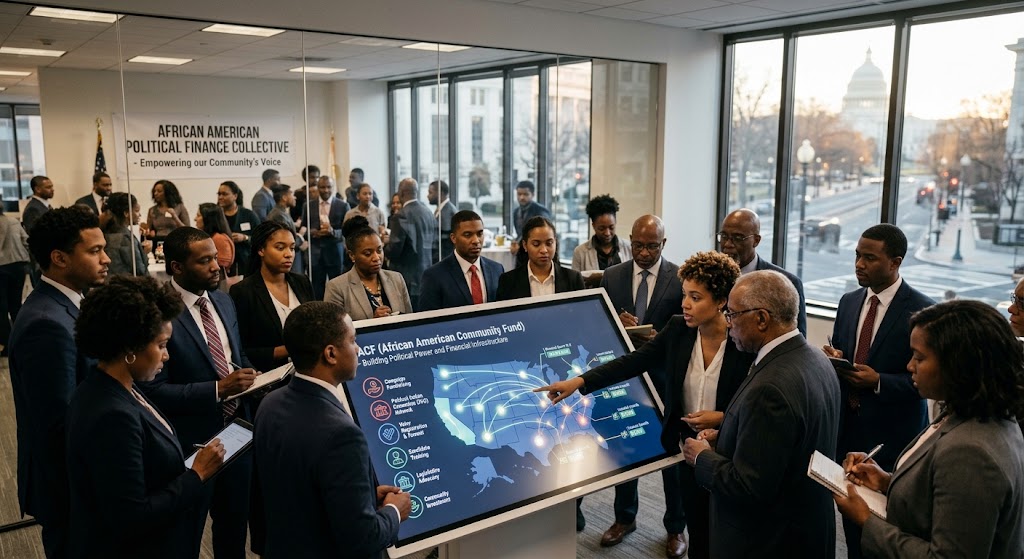
The strategic implications point toward a specific institutional build, not a rhetorical shift. African America does not need a larger version of what exists. It needs a different kind of institution entirely: a standing, coordinated political finance vehicle, structurally similar to what the donor blocs behind Maga Inc or One Nation represent, but built and governed inside the ecosystem; meaning owned, staffed, and directed by African American institutions rather than routed through outside intermediaries. This means, concretely, several things happening in sequence rather than in isolation. It means African American banks and credit unions, roughly $15 billion in combined assets held across seventeen Black-owned banks and 205 Black-owned credit unions nationally, positioning themselves to hold the treasury accounts and compliance banking relationships for these political vehicles, rather than ceding that function, and the fee revenue and deposit base that comes with it, to mainstream white-owned institutions by default. It means HBCU law schools at Texas Southern, Southern University, and North Carolina Central building dedicated campaign finance and election law tracks that produce the specialized compliance talent this infrastructure requires, rather than leaving that talent pipeline to develop by accident or not at all. It also means confronting a narrow base: only five HBCUs operate law schools at all, and four of the five — Texas Southern, Florida A&M, North Carolina Central, and Southern — are public institutions answerable to state legislatures and governing boards that are not uniformly receptive to political finance infrastructure, however framed. Howard, the sole private HBCU law school, faces no such constraint. That asymmetry points toward where expansion is most plausible: one or two well-resourced private HBCUs — institutions like Tuskegee, Xavier of Louisiana, or Dillard — developing law schools of their own, with campaign finance and election law built into the founding curriculum rather than added later as an afterthought to a traditional bar-passage-first model. It means business schools at Fort Valley State, Alcorn State, and Delaware State training the treasurers and financial officers who run political committee operations with the same rigor applied to corporate finance training. It means a standing talent-identification pipeline running through these same schools and their alumni networks, tracking promising local and state officeholders the way a scouting operation tracks prospects, and directing early, deliberate investment toward them well before a congressional or statewide run is even plausible. It means consolidating the current landscape of small, disconnected African American political action committees into a smaller number of larger, coordinated vehicles capable of the kind of early, concentrated primary spending that actually shifts outcomes, rather than the current pattern of symbolic contributions spread too thin to matter. And it means treating the media buying, legal, and consulting contracts these vehicles generate as an economic development opportunity for Black-owned firms, not a pass-through expense to whichever mainstream firm happens to have the existing relationship.
None of this requires abandoning turnout organizing, and none of it requires a larger aggregate sum of money than African America currently commands in the ecosystem. What it requires is the same thing every other successful American political finance apparatus required: deliberate institutional construction, sustained over multiple election cycles, governed by people who understand that capital positioned early and coordinated tightly outperforms capital raised reactively and spent diffusely — every single time. Lesser-known institutions like Tougaloo, Grambling, and Edward Waters are not typically where this conversation gets held, but they are exactly where the compliance officers, treasurers, and campaign finance attorneys of the next decade should be trained, because a model of institutional development that concentrates all attention on a handful of flagship schools has already proven too narrow to build the density this problem requires. The billionaires behind Maga Inc did not wait for a moral consensus to build their $400 million war chest. They built the plumbing first. African America’s political future depends on doing the same, not instead of the vote, but as the infrastructure without which the vote, on its own, will keep losing to the primary it never had the capital to contest.
Disclaimer: This article was assisted by ClaudeAI.

