“In order to develop Diaspora infrastructure, then African America needs to think at that level. It needs to structure and coordination among our institutions so that we speak with some uniformed and consistent voice of partnership to our Diaspora brothers and sisters.” – William A. Foster, IV
A trading house on the coast once sent all of its goods to a distant port through the king’s envoy. The envoy held the house’s letters of credit, spoke for it in the harbor council, and put his seal on its contracts. Over generations the house grew prosperous and forgot that no one in that port knew its name. When the king recalled the envoy, the house’s cargo stayed on the docks. The market was still open and the goods were still wanted. The house simply had no standing of its own. Rivals who had kept their own agents took the trade within one season. The house had never lacked goods. It had relied on someone else’s envoy instead of keeping its own.
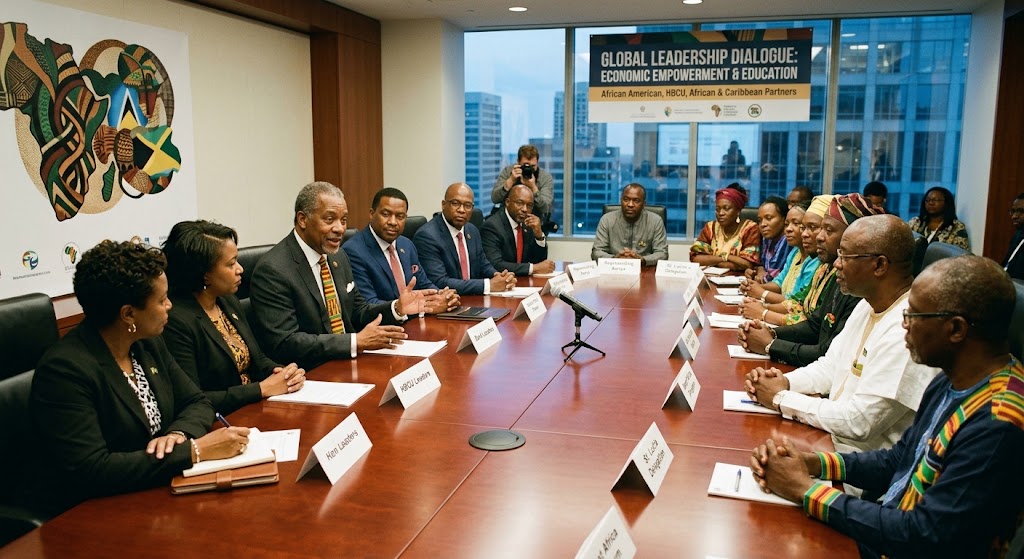
For most of the postwar era, African America has reached the multilateral system through a single intermediary: the government of the United States. That arrangement is now breaking down, and it reveals a structural weakness that predates any one administration. Communities that hold international standing only through their national government have borrowed standing, not their own. The question in front of HBCUs, Black banks and credit unions, and the wider institutional ecosystem is not whether to regret Washington’s retreat. It is whether African American institutions will build their own seats in the rooms Washington has left, before other actors fill them.
The scale of the retreat is now clear. On January 7, 2026, President Trump signed a presidential memorandum that, according to its own text, followed a review ordered under Executive Order 14199, in which the Secretary of State was directed to examine every intergovernmental organization the United States belongs to or funds. The White House said 66 organizations were covered, 31 of them United Nations entities and 35 outside the UN system. As TRT Afrika and other outlets reported, these come on top of earlier exits: the administration had already moved to leave the World Health Organization, the Paris climate agreement, and UNESCO, and had ended engagement with the UN Human Rights Council and extended the halt to UNRWA funding.
Most American coverage focused on the climate bodies. Africa Core read the list differently. Writing in South Africa’s BusinessDay, Aaliyah Vayez noted that three of the institutions on the list matter especially to the continent: the Economic Commission for Africa, the Office of the Special Adviser on Africa, and the Permanent Forum on People of African Descent. The chairperson of the African Union Commission, Mahmoud Ali Youssouf, issued a statement naming the ECA, UN DESA, UNCTAD, the Special Adviser’s office, UN Women, UNFPA, and the peacebuilding bodies as entities that play an important role on the continent. In Nairobi, which hosts one of the UN’s largest duty stations, local analysts cited by Kenya’s The Standard put the US-linked funding for Nairobi-based UN operations at risk at $250 million to $350 million a year.
The Permanent Forum deserves particular attention, because its inclusion shows what the withdrawal actually changes. The Forum is the only body in the UN system whose mandate is the African diaspora itself. The State Department described it as a front for activists pursuing race-based wealth redistribution and reparations, and announced the U.S. exit. Yet the withdrawal took almost nothing away from the Forum. A coalition of civil society organizations, in a statement published by WOLA, pointed out that the United States had stopped participating in the Forum in January 2025 and had never funded it. According to the UN human rights office, its fifth session opened in Geneva in April 2026 as scheduled, under a theme tied to the Second International Decade for People of African Descent.
The lesson is institutional, not rhetorical. The Forum does not need Washington in order to meet, and African America does not need Washington in order to attend. OHCHR’s call for participation welcomes national human rights institutions, civil society, academics, experts, and organizations of people of African descent alongside member states. The door is open to non-state institutions. What has been missing is a set of African American institutions organized to walk through it with continuity, a mandate, and capital behind them.
History shows both the potential and the recurring failure. African American institutions have shaped the independent Africa that now sits in the General Assembly. Lincoln University in Pennsylvania educated Kwame Nkrumah and Nnamdi Azikiwe, who went on to lead Ghana and Nigeria respectively. Ralph Bunche, a Howard political scientist, became the UN’s most consequential early mediator and won the Nobel Peace Prize for it. Texas Southern University’s public affairs school carries the name of Mickey Leland, who died in Ethiopia in 1989 on a famine relief mission. Each of these was a real channel of influence. But each ran through individuals, and individuals retire, die, or change posts. None of these moments produced a durable institution with a permanent seat, a secretariat, a budget line, and a successor pipeline. This publication’s founding premise applies directly: communities rise or fall on the strength of their institutions, not the brilliance of their individuals. The diaspora’s international record is a record of brilliant individuals.
The closest thing to an institutional channel shows how thin the infrastructure is. By the Core Planning Group–Office of HBCU Development and International Cooperation’s own account, in September 2019, on the margins of the 74th General Assembly, it co-organized a summit of Africa and diaspora colleges and education ministers with UNDP’s Regional Bureau for Africa and an ECOSOC-accredited NGO, and signed a memorandum of understanding with UNDP. That is a precedent worth building on. It is also, seven years later, largely unknown across the 107 federally designated HBCUs. Its existence depended on borrowing a partner’s accreditation.
Three structural problems explain why the ecosystem has not built its own presence.
The first is dependence on intermediaries. African American institutions have treated international engagement as something that happens through federal programs, State Department fellowships, and government-to-government delegations. When the federal government withdraws, the whole channel closes. This is the same exposure HBCU Money has documented in domestic finance: a community served by institutions it does not own is at risk whenever those institutions decide to leave.
The second is legal constraint. Public HBCUs in states hostile to their missions have limited freedom to take on international advocacy directly. A state university in Mississippi or Florida faces political and budgetary pressure that a private institution does not. Their alumni associations and foundations, however, are legally independent nonprofits. They are exactly the kind of entity the multilateral system is built to admit.
The third is fragmentation. No consolidated international office represents the ecosystem. Each university’s global programs office negotiates alone, usually for study-abroad logistics rather than standing. Black-owned banks and credit unions, which hold roughly $15 billion in combined assets across 17 banks and 205 credit unions according to HBCU Money’s 2025 directories, have no coordinated international posture at all. Scattered institutions cannot hold a seat. Coordinated ones can.
There is also the question of who else will fill the vacancy. The common assumption is that Beijing steps in wherever Washington leaves. The evidence is more mixed, and that is exactly what makes the opening available. Research from the Foreign Policy Research Institute finds that Chinese pledges under the UN umbrella amount to fractions of past American commitments; its $550 million five-year WHO pledge compares with $752 million the United States gave in 2024–25 alone. China’s UN ambassador, Fu Cong, has said Beijing has no interest in replacing the United States and described China as already the de facto top contributor to the UN regular budget. Where Beijing is active, it is selective. The Japan Times reports that China is extending its influence through lower-profile agencies that set standards in contested fields such as artificial intelligence. China is taking the positions it values and leaving the rest. Seats on the Africa and diaspora agenda are among those still unclaimed.
Other pressure falls directly on the talent pipeline. Devex reported that Chinese diplomats have pushed the UN to shrink its American workforce in line with falling U.S. contributions, arguing that any cuts caused by the loss of U.S. funding should fall hardest on American nationals. For HBCU graduates who have seen the international civil service as a career path, that door is narrowing. If the ecosystem wants its talent in international institutions, it will need pathways that do not depend on American quota politics, including the African Union Commission, the African Development Bank, Afreximbank, and the ECA itself.
The strategic timetable favors early movers. The General Assembly proclaimed the Second International Decade for People of African Descent in December 2024; it began on January 1, 2025 and ends on December 31, 2034. According to Representative Sydney Kamlager-Dove’s office, which pushed for the resolution in Congress, it was co-sponsored by 87 member states and adopted by consensus. That is an eight-year runway with a standing international mandate that no single government can repeal. The African Union already treats the diaspora as its sixth region. Africa Core governments are recalibrating their external relationships, and the diaspora’s value as a third force between Washington and Beijing, an argument HBCU Politics has made before, rises when Washington steps back. Institutions that establish themselves in the next two to three years will shape the Decade’s agenda. Those that wait will find the chairs taken.
The response should be concrete and should rely on vehicles that already exist.
First, the ecosystem should pursue ECOSOC consultative status through a purpose-built consortium nonprofit. The bar is achievable. Under the eligibility rules published by ECOSOC’s NGO Branch, an applicant must have been registered as a nonprofit for at least two years, have an established headquarters, a democratically adopted constitution, and accountability mechanisms; organizations created by governments are excluded. That exclusion is why the vehicle should be built by HBCU alumni foundations, private institutions such as Dillard, Tougaloo, Fisk, and Bethune-Cookman, and Black-owned banks and credit unions, not by state-controlled campuses. Accredited organizations can attend official UN meetings, submit written and oral statements, host side events, and engage member states directly. ECOSOC sets June 1 as the annual application deadline for review in the following cycle. A consortium chartered now would be eligible within two years.
Second, the ecosystem should send an organized, standing delegation to every session of the Permanent Forum, not scattered individual attendees. The Forum alternates between Geneva and New York, so every other session sits within reach of the Northeast corridor HBCUs: Morgan State, Coppin State, Lincoln, Cheyney, Delaware State. Each delegation should arrive with written submissions produced by HBCU research centers, so that the Forum’s record on economic exclusion, land loss, and capital access is built on data from our own institutions.
Third, HBCUs should sign research agreements with the Economic Commission for Africa in Addis Ababa in the fields where they have real capacity. The 1890 land-grant institutions, including Fort Valley State, Alcorn State, and North Carolina A&T, hold agricultural research capacity relevant to the ECA’s work on food systems and the African Continental Free Trade Area. Texas Southern’s public affairs school and Jackson State’s urban research tradition are relevant to the ECA’s work on urbanization. The ECA has lost American support. It has not lost its need for partners.
Fourth, the ecosystem should build a talent pipeline into Africa Core multilateral institutions. With American staffing positions at the UN under pressure, HBCU career offices and alumni networks should build deliberate placement channels into the AU Commission, the African Development Bank, and Afreximbank. This concentrates diaspora talent inside institutions whose influence is growing rather than shrinking.
Fifth, Black-owned banks and credit unions should establish correspondent relationships with African financial institutions. Capital that cannot cross borders cannot support diplomatic standing. An ecosystem that holds roughly $15 billion in combined assets and no cross-border relationships is under-leveraged by design. Correspondent banking is present-tense practice, not speculative instrumentation. It is the plumbing that eventually lets a diaspora consortium fund its own delegations, research, and secretariat without asking permission.
The deeper point is about permanence. A government’s seat at the table changes with each election, and the past eighteen months have shown how quickly a presence can disappear from Geneva, Addis Ababa, and Nairobi. An institution’s seat does not depend on elections. A consortium with consultative status, a standing research relationship with the ECA, and a staffing pipeline into Africa Core institutions keeps its standing whoever occupies the White House. The trading house in the parable did not lose its market because the king was hostile. It lost its market because it had never kept its own agent. African America has eight years left in the Second International Decade to avoid that mistake.
Disclaimer: This article was assisted by ClaudeAI.

