Do not remove the kinks from your hair – remove them from your brain. ― Marcus Garvey

In 1921, the Greenwood District of Tulsa, Oklahoma, a self-sufficient Black economic enclave so prosperous it had earned the name “Black Wall Street”, was destroyed not by market forces or institutional failure, but by a coordinated mob, with the tacit cooperation of local government officials who deputized some of its members. The survivors did not receive reparations. They received no federal intervention. What they received, in the years and decades that followed, was a series of government-endorsed urban renewal projects that completed the dispossession the mob had started. The lesson Greenwood offered, a lesson repeated across American history from Reconstruction to the present, was not that African Americans needed to persuade their opponents of the injustice being done to them. The residents of Greenwood knew the injustice. Their opponents knew it too. The lesson was that persuasion, absent structural power, is theater.
This history is not past. It is the operating context for every HBCU president who has sat across a table from a state legislature demanding performance metrics that flagship predominantly white institutions are never asked to meet. It is the context for every Black institution that watched federal Pell Grant surpluses, dollars earned disproportionately by HBCU students, get redirected into general revenue by states hostile to HBCU missions. It is the context for every accreditation review applied with more scrutiny to an institution like Cheyney University of Pennsylvania, the nation’s oldest HBCU, than to comparable institutions with larger endowments and more politically connected governing boards. These are not anomalies. They are patterns, and patterns have architecture.
African American institutional strategy has too long been organized around a central and deeply costly assumption: that demonstrating merit, documenting injustice, and appealing to stated principles will, over time, produce equitable outcomes. This assumption has driven generations of litigation, lobbying, coalition-building, and patient institutional participation in systems whose written rules were not always honored when Black institutions approached the door. The energy expended on this work has been extraordinary. The returns, measured in institutional balance sheets, endowment parity, or political autonomy, have been insufficient.
The point is not that litigation is worthless or that advocacy produces nothing. The Civil Rights Act, the Voting Rights Act, and the institutional survival of dozens of HBCUs through public funding battles represent real, hard-won victories. But there is a category error embedded in the strategy that produced those victories, a confusion between the floor and the ceiling. Legislation establishes floors. It stops the most egregious forms of exclusion. It does not build institutions. It does not accumulate capital. It does not produce the kind of structural redundancy that makes a community resilient when the political winds shift, as they always do. Floors are not foundations. African American institutional power requires foundations.
The Diaspora Projects, in its recently issued position paper on “Africa Core,” offered a clarifying framework when it argued that language itself carries embedded assumptions about hierarchy and power and that a region defined by what it is beneath cannot be fully seen for what it is at the center. The same logic applies to institutional strategy. A community whose primary public posture is one of appeal — appealing to conscience, to consistency, to stated democratic ideals — has accepted a subordinate position in the architecture of power before the negotiation begins. The posture of appeal is not strategic. It is a concession.
The alternative is not antagonism. It is architecture. The most successful ethnic and national communities in American institutional life such as Jewish American educational networks, Cuban American civic infrastructure in South Florida, Indian American professional associations and their political giving corridors did not primarily build their institutional power by persuading the existing establishment to honor its stated commitments. They built parallel structures. They created institutional density: universities, banks, hospitals, media organizations, philanthropic vehicles, and political networks that reinforced each other and reduced dependence on goodwill from outside the community. Their leverage in mainstream institutions grew in direct proportion to their capacity to function without them.
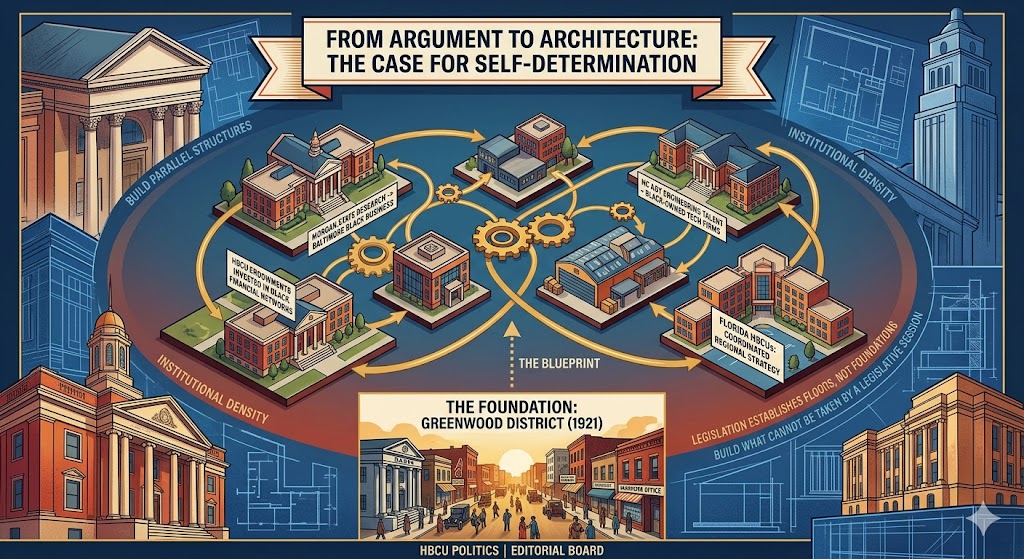
HBCUs are the most important piece of the African American institutional architecture, and they remain structurally underutilized in this regard. Consider what an intentional approach to institutional density would require. Morgan State University in Baltimore, a designated national research university, sits in a city with a majority Black population, a historically Black political class, and multiple anchor institutions including hospitals, a port economy, and a state government. The question is not whether Morgan State is doing good work, it is. The question is whether the economic circuit between Morgan State’s research enterprise, Baltimore’s Black political leadership, Maryland’s state procurement system, and the broader HBCU financial ecosystem is operating at the scale the institutional assets would permit. It is not. The circuit is incomplete.
The same analysis applies at Grambling State University in Louisiana, where an institution with a national athletic brand and deep alumni loyalty sits in a region of significant agricultural and energy economics without a corresponding HBCU-anchored investment vehicle to capitalize on proximity. It applies at Fort Valley State University in Georgia’s Peach State corridor, where agricultural science programs exist in geographic and institutional isolation from the broader food systems economy. It applies at North Carolina A&T State University in Greensboro, the largest HBCU in the country by enrollment, whose engineering programs produce talent that systematically exits the HBCU economic circuit for corporate employers with no structural relationship to the institution that trained them.
None of these gaps are the product of insufficient Black excellence. They are the product of insufficient institutional architecture, the absence of the connective tissue that transforms a collection of capable institutions into an interdependent ecosystem with self-reinforcing capital velocity. A student trained at North Carolina A&T whose career is built at a Black-owned firm that banks at a Black-owned financial institution, invests through an HBCU-affiliated fund, and ultimately endows a chair at the institution that trained them — that is a closed loop. That loop currently exists in fragments. The work of African American institutional strategy in this generation is to close it.
Closing it requires a hard reorientation of both energy and attention. The legislative session is not where this work happens, though legislation matters at the margins. The foundation meeting is not where this work happens, though philanthropic capital has a role. The work happens in the decisions HBCUs make about where they bank, what vendors they contract, where their endowments are invested, and which partnerships they pursue with whom and on what terms. It happens when Bethune-Cookman University and Florida Memorial University and Edward Waters University, three HBCUs within two hundred miles of each other in Florida, develop coordinated strategies around the state’s growing technology and logistics economies rather than competing for the same regional donors. It happens when the African American-owned bank ecosystem, anchored by institutions like Liberty Bank and First Independence Bank, develops structured relationships with HBCU treasury operations that keep institutional deposits in Black hands rather than allowing them to flow reflexively to the largest regional bank with a relationship manager who attended an HBCU golf tournament.
This is not a utopian argument. It is a strategic one, grounded in the straightforward observation that institutional power is built through deliberate institutional decisions accumulated over time. The communities that have it did not receive it from a more powerful establishment that was persuaded to share. They built it. And they built it, in many cases, precisely because the mainstream establishment’s hostility removed the option of waiting for inclusion as a strategy.
African America has been handed, through the hostility of history, the same clarifying condition. The rules change at the door. The goalposts move. The standards shift. This is not new information. It is the operational reality of every HBCU that has watched a state legislature defund an academic program the week after it enrolled its first majority-Black cohort, or seen a federal grant disappear into a reinterpretation of eligibility criteria that had been settled for a decade. The response to this reality cannot continue to be renewed rounds of documentation, litigation, and appeal to stated principles. The response must be structural: build what cannot be taken by a legislative session, accumulate what cannot be redistributed by an administrative ruling, and create institutional facts on the ground that change the calculus of those who have historically seen Black institutional ambition as something to be managed rather than accommodated.
The Greenwood generation built Black Wall Street in a single generation following Reconstruction. They did not build it by persuading Tulsa’s white establishment of their worthiness. They built it through commercial discipline, institutional loyalty, and the deliberate retention of capital within a defined community. The mob understood what the Greenwood residents had built better than many contemporary analysts do: they did not burn Greenwood because it had failed. They burned it because it had succeeded. What was destroyed in 1921 can be rebuilt. But it will not be rebuilt through argument. It will be rebuilt through architecture.
Disclaimer: This article was assisted by ClaudeAI.

