Africa’s Health Security and Sovereignty Agenda is non-negotiable. It represents our collective commitment to move from dependency to ownership, and from vulnerability to resilience. Health sovereignty does not mean isolation — it signals a new model of partnership in which African nations lead with clarity and confidence, and global partners support African-defined priorities. – H.E. Dr. Jean Kaseya, Director General, Africa CDC, November 2025
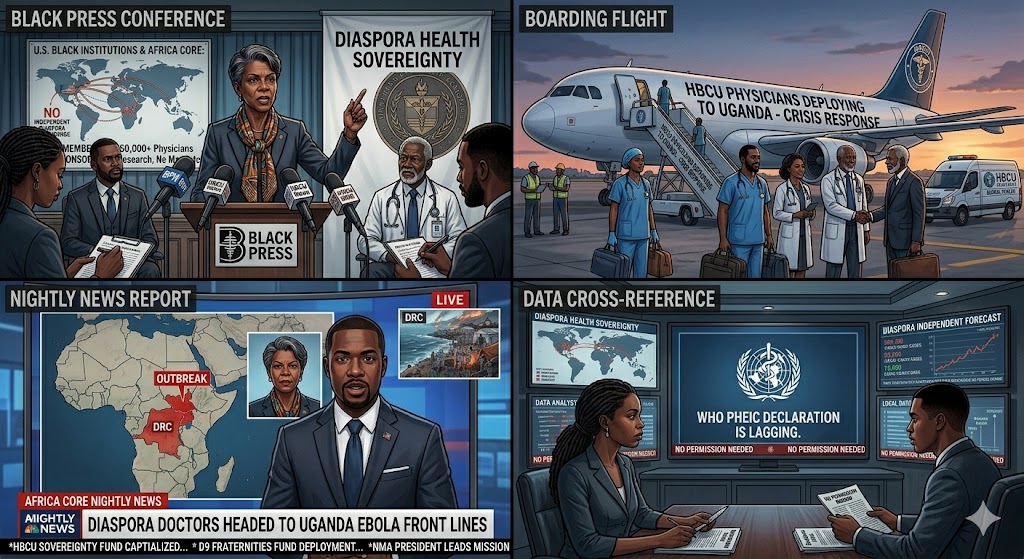
Imagine a family that has been separated for generations. The circumstances of the separation were violent — the family did not choose it — and the distance between its two halves is now measured in oceans. The half that was carried away has built a life. It has built institutions: schools, hospitals, professional associations, fraternal orders, a press, a political caucus. These institutions have their own histories, their own ambitions, their own internal debates about what the family owes to itself. The half that remained in the homeland has faced its own trials from colonization, extraction, war, the slow violence of underfunded health systems and the fast violence of hemorrhagic fever moving through a mining town in a province that the world notices only in crisis. Now the homeland is sick. The fever has a name. The dead are being counted. And the half that was carried away is waiting as it has always waited for someone outside the family to tell it that the homeland needs help. It is waiting on a bureaucracy in Geneva. It is waiting on a declaration. It is waiting, in other words, for permission to care. The question this article asks is why and what it would take to stop waiting.
The Diaspora learned about the Bundibugyo Ebola outbreak in Ituri Province because Geneva said so. That dependence on the WHO, an organization with a documented history of subordinating African health sovereignty to geopolitical calculation, is not a contingent failure of awareness. It is a structural choice made by default. This article asks why the Diaspora is waiting on Geneva, what an independent health forecasting capability would require, and why neither the institutions positioned to build it nor the philanthropic networks positioned to fund it have yet decided that doing so is an obligation.
On May 15, 2026, laboratory analysis at the Institut National de Recherche Biomédicale in Kinshasa confirmed what community deaths in Mongwalu and Rwampara had been signaling for weeks: the Democratic Republic of the Congo was in the opening phase of its seventeenth declared Ebola outbreak. Within forty-eight hours, Uganda confirmed two imported cases in Kampala. Within seventy-two hours, the World Health Organization declared the Bundibugyo virus disease a Public Health Emergency of International Concern, the highest formal alert level in global health governance. The declaration arrived on May 17. The index case is believed to have fallen ill on April 25. The Diaspora learned about the outbreak because Geneva said so. And across the full architecture of African American institutional life from the medical schools, the fraternal orders, the alumni associations, the professional organizations, the political formations, the Black press there has been, with rare exception, silence.
Before cataloguing that silence, a prior question deserves to be stated plainly: why is the African Diaspora waiting on the World Health Organization to tell it that the homeland is in crisis? The WHO PHEIC declaration is the moment at which the global health apparatus formally mobilizes. It is also, by design, a lagging indicator arriving after the outbreak has already established itself, after the detection gap has compounded transmission, after the healthcare workers have already died. In the 2014 West Africa Ebola outbreak, the WHO did not declare a PHEIC until August, five months after Guinea and Liberia had formally notified the organization of domestic outbreaks. Internal documents obtained by the Associated Press and confirmed by subsequent review panels showed that WHO Geneva had been receiving field reports from its own Africa staff as early as mid-April 2014, describing a hidden and spreading epidemic. The delay was not primarily scientific. Internal deliberations cited concern that a PHEIC declaration could anger the affected African governments, damage their mining economies, and interfere with the Muslim pilgrimage to Mecca in October. Eleven thousand people died in that outbreak. The WHO’s own review panel subsequently acknowledged significant and unjustifiable delays in the PHEIC declaration. For the Diaspora to be waiting on this organization as its primary mechanism for knowing that the homeland is in danger is not a contingent failure of awareness. It is a structural choice made by default rather than by design.
The WHO’s complicated history with the African continent is not incidental background. When the WHO was founded in 1946, the creation of its Africa regional office was the most politically fraught of its six regional divisions because colonial powers feared that international health oversight would function as a vehicle for criticism of colonial governance. The imperial calculation was that African health was a colonial administrative matter, not an international public health concern. That founding architecture inscribed a subordination of African health sovereignty into the WHO’s regional structure that has never been fully resolved. The WHO African Regional Office has been consistently characterized in the governance literature as the most politically constrained and underfunded of the six WHO regions, a body whose deference to member state politics has historically slowed outbreak response. The Bundibugyo outbreak’s four-week detection gap is in part a product of this inherited architecture: surveillance systems in Ituri Province that were never adequately funded, field epidemiology capacity further degraded by the 2025 disbanding of USAID and the cancellation of major foreign-funded health programmes, and a global health governance structure that was not designed to serve Africa Core as a sovereign health actor. The Diaspora inherits none of the authority of that system. It receives only its outputs filtered through the political calculations of an institution that has repeatedly demonstrated it will delay on behalf of African economic interests while African people die.
In the current outbreak, the pattern holds. The index case developed symptoms on April 25. Laboratory confirmation arrived on May 14. The PHEIC was declared on May 17. By the time the declaration landed, 246 suspected cases and 80 suspected deaths had accumulated across three health zones in Ituri Province, with cases confirmed in Kinshasa and both Kampala intensive care units. The WHO’s own emergency declaration noted that the detection failure reflected a low clinical index of suspicion among healthcare providers, compounded by co-circulating arboviruses masking the outbreak’s signature and ongoing conflict restricting surveillance teams. These are systemic conditions, not anomalies. They are predictable features of the Ituri Province health environment that any institution with sustained field presence and epidemiological attention to Africa Core would have been tracking continuously. The Diaspora was not tracking them. It had no mechanism for tracking them. It knew what Geneva eventually chose to say, when Geneva chose to say it.
This is the argument for Diaspora health forecasting as an independent institutional function not as an aspiration, but as a concrete and buildable capability with a specific operational design. At its core, it would require a standing epidemiological intelligence unit embedded within or formally connected to the HBCU medical and public health ecosystem, staffed by researchers with sustained field relationships in Africa Core’s highest-risk outbreak zones. It would monitor the endemic disease landscape for hemorrhagic fever activity, seasonal co-circulation patterns, the conflict dynamics that degrade surveillance capacity on a continuous basis, not in response to WHO alerts. It would maintain direct communication channels with the INRB in Kinshasa, with Africa CDC’s regional surveillance networks, with field epidemiology training program graduates across the continent. It would produce its own threat assessments circulated to HBCU leadership, to the Congressional Black Caucus Global African Affairs task force, to the Black press on a regular schedule. The technology required is not exotic. The expertise required sits, partially assembled, in the faculties of Morehouse School of Medicine, Howard University, and Meharry Medical College. The National Medical Association represents more than 50,000 African American physicians. What does not exist is the institutional decision to organize any of this toward a Diaspora intelligence function rather than toward the domestic health disparities frameworks that currently absorb it entirely.
The HBCU medical ecosystem is the most instructive case, because it is the one where genuine infrastructure meets genuine inaction. Four institutions — Morehouse School of Medicine, Howard University, Meharry Medical College, and Charles R. Drew University of Medicine and Science — constitute the HBCU Global Health Consortium, operating HIV/AIDS clinical programs in Lusaka, Zambia under PEPFAR and HRSA funding. Morehouse’s Office of Global Health Equity maintains active research partnerships across more than a dozen countries through the Fogarty International Center’s UJMT consortium, places doctoral researchers at African institutions for twelve-month attachments, and has embedded a former executive director of the African Field Epidemiology Network, a U.S. CDC implementing partner operating across more than thirty African countries, on its faculty. The Consortium of African American Public Health Programs brings together public health programs at ten HBCUs. When the Bundibugyo confirmation came, none of these institutions issued a public statement, announced a deployment, or published a coordinated position. The issue is not the absence of expertise. It is the absence of mandate — the institutional decision, never made, that Africa Core health crisis response is part of what these organizations exist to do.
The HBCU Global Health Consortium deserves particular examination, because it represents the closest existing vehicle to what a Diaspora health intelligence function would require and because its current form reveals precisely how large the gap is. As presently constituted, the Consortium functions as a programmatic collaboration among four medical schools, primarily oriented toward executing federally funded service delivery in Zambia. That is valuable work. It is not an organization capable of independently receiving competitive NIH or CDC research grants, executing multi-site clinical trial protocols, holding intellectual property developed by its member institutions, or negotiating direct partnership agreements with Africa CDC or the African Medicines Agency. It cannot commission its own epidemiological assessments of emerging threats in Africa Core, let alone publish those assessments and route them to Diaspora institutions before WHO declarations force the question. What is required is not a better-funded version of the current structure but a reconstituted institution of one with independent governance, legal standing, executive leadership, and the capitalization to function as a peer in the global health research architecture rather than as a sub-grantee executing someone else’s agenda. That institution has not been designed. The conversation that would design it has not been had.
The National Medical Association and its 50,000 African American physicians, the oldest and largest organization of Black doctors in the United States, with a peer-reviewed journal explicitly dedicated to clinical research on health problems affecting African Americans has not issued a statement on the Bundibugyo outbreak. It has not convened an emergency session of its global health committee, because no standing global health committee with an Africa Core mandate exists within its organizational structure. The NMA’s programmatic work is oriented almost entirely toward domestic health disparities: cardiovascular disease, maternal mortality, diabetes, HIV/AIDS in American communities. These are legitimate and urgent priorities. They do not exhaust the obligations of 50,000 Black physicians to the people dying in Ituri Province from a hemorrhagic fever with no vaccine. The NMA is the institution best positioned to provide the physician and researcher network through which a Diaspora health intelligence function could be staffed and operationalized connecting Black physicians with Africa expertise to Africa CDC, routing clinical guidance to HBCU medical school partners, and providing the professional authority to negotiate alongside, rather than beneath, the global health research establishment. That function does not currently exist within the NMA’s institutional architecture. Its mandate does not require it.
The Divine Nine and HBCU alumni associations occupy a different position in this analysis than the medical schools and professional organizations, and the distinction matters. These are social institutions. They are not health organizations, and it would be a misreading of their function to ask why they failed to produce an epidemiological response. The question their silence raises is different and more tractable: why is the philanthropic capacity of these organizations not strategically oriented toward the institutions that would build a Diaspora health sovereignty infrastructure? The nine historically Black fraternities and sororities collectively claim approximately four million members in the United States. HBCU alumni associations represent the graduate networks of more than 100 institutions, including the medical schools and public health programs that already have Africa field relationships. These networks raise money. They direct that money toward scholarships, campus building campaigns, endowment gifts, and service projects that are selected chapter by chapter, year by year, with no coordinating framework that asks what the aggregate of that giving could build if it were oriented toward a shared institutional objective. A standing Diaspora health research institution the kind of independent, capitalized, governance-credentialed body that could receive NIH grants, hold patents, and maintain Africa Core field presence between crises requires sustained philanthropic investment that no single HBCU endowment can currently provide alone. The D9 and HBCU alumni associations are the natural capital formation vehicles for that investment. They are not being asked to be. No institution is doing the asking. No shared framework for what that capital would build has been articulated in any public forum these networks participate in.
The argument across these cases converges on a single finding: the institution specifically designed to anchor Diaspora health sovereignty does not exist, is not being designed, and is not the subject of any strategic conversation that this publication can find evidence of. What such an institution would require is not mysterious. A Diaspora Health Intelligence and Research Institute: independent legal standing; governance representation from the HBCU medical schools, the NMA, and Africa-focused public health programs; continuous epidemiological monitoring capacity in Africa Core’s highest-risk outbreak zones; direct field relationships with the INRB in Kinshasa, Africa CDC, and national public health institutes across the continent; and a publication mandate that routes threat assessments to every relevant Diaspora institution before the WHO calendar forces the question. Alongside it, the capital vehicle: a Diaspora Health Sovereignty Fund, capitalized through D9 and alumni association strategic philanthropy, Black professional association giving, and HBCU endowment contributions, structured with the legal form to deploy that capital into field infrastructure between crises rather than only in response to them. The components are present in dispersed form across the institutional ecosystem. The integration has never been attempted. The conversation that would attempt it is not happening.
The more productive question and the one the African American institutional community has conspicuously avoided asking is what organization would anchor Diaspora health sovereignty if not the ones examined here. The HBCU Global Health Consortium has the field relationships but not the institutional independence. The National Medical Association has the physician network but not the Africa Core mandate. The Congressional Black Caucus has the legislative authority but not the strategic framework. The D9 and alumni associations have the philanthropic potential but not the coordinating architecture. Each of these institutions is necessary but not sufficient. What is missing is a purpose-built node: an organization whose founding mandate is explicitly Diaspora health sovereignty not health equity in domestic communities, not global health in the generic sense, but the specific project of building Africa Core epidemiological intelligence capacity, maintaining field presence in high-risk outbreak zones, and positioning the African American institutional ecosystem as a peer partner in the global health research architecture rather than a downstream recipient of its outputs. Whether that organization emerges as a reconstitution of the HBCU GHC, as a new institution seeded by NMA leadership and HBCU presidential commitment, or as something built from outside the existing institutional landscape entirely, the precondition is the same: someone has to decide it needs to exist. That decision has not been made. The conversation that would make it has not been had.
The Congressional Black Caucus occupies a distinct position, because it carries formal institutional authority that civil society cannot replicate. Its Global African Affairs task force has an explicit mandate covering the continent and the Diaspora, appropriations leverage, committee oversight authority, and the credibility to demand executive briefings and drive agency accountability. During the 2014 Ebola outbreak, congressional leaders formally requested CDC briefings on the DRC response which is the kind of engagement that shapes resource allocation and signals that African American political power has a stake in the outcome. The Global African Affairs task force has not made a comparable request on the 2026 Bundibugyo outbreak. It has not convened a hearing. More importantly, it has not used its legislative position to advance what should be a cornerstone of its Africa Core health agenda: mandating a formal partnership between a reconstituted HBCU health research institution and Africa CDC, requiring that NIH and CDC global health funding allocate a defined share to HBCU-led principal investigators working in Africa Core, and directing U.S. diplomatic engagement with the African Union to formally recognize the Diaspora health ecosystem as a peer partner institution. These are achievable legislative actions. They are not being proposed because the strategic conversation that would produce them is not happening.
The Black press carries accountability of a specific kind, because it is the institution best positioned to generate the public conversation that every other institutional failure depends on. The National Newspaper Publishers Association represents more than 200 African American-owned community newspapers with a stated mission to be the voice of the Black community. A hemorrhagic fever with a 30 to 50 percent fatality rate, spreading without a vaccine through the ancestral homeland and declared a global public health emergency, is by any editorial standard a story that impacts the Black experience. It is not being led. It is not being framed as a Diaspora story. It is not being used to ask the institutional questions this article is asking. A press that cannot connect Ituri Province to the institutional obligations of its readership cannot generate the public pressure required to start the conversations the community is not having. The professional associations, the alumni associations, the NMA membership, the HBCU presidents none of them will feel the weight of this failure until a press that reaches them names it as one.
What is being described across these institutional failures is not a collection of independent organizational shortcomings. It is the absence of a single strategic conversation specifically, the conversation about what Diaspora health sovereignty would actually require, who would build it, and how it would be capitalized. That conversation would need to engage the WHO dependency directly, not as a complaint about an external institution but as a design brief for an internal one. A community that outsources its threat recognition to Geneva has decided, implicitly, that its homeland’s health is someone else’s monitoring responsibility. Reversing that decision requires building, in sequence: the epidemiological intelligence function that produces independent threat assessments; the legal and governance structure that allows the HBCU medical ecosystem to act on those assessments independently; the philanthropically capitalized fund that sustains field presence between crises; and the communications infrastructure that routes Diaspora health intelligence to every institution capable of converting awareness into action. The HBCU GHC is the starting framework for the research institution. The NMA is the physician network. The D9 and HBCU alumni associations are the capital formation engine. The Congressional Black Caucus is the legislative lever. The Black press is the mobilization channel. None of them are being organized toward this purpose. None of the conversations that would organize them are occurring.
The Bundibugyo outbreak will be contained. Africa CDC is coordinating. The WHO machinery will do what it does, on the timeline it does it, shaped by the political calculations that have always shaped it. The question the Diaspora must now answer not after the outbreak is over, but during it is whether it will continue to learn about crises in the homeland when Geneva says so, or whether it will build the institutional capacity to know first. A community with four HBCU medical schools holding established Africa field partnerships, 50,000 organized Black physicians, four million fraternal organization members, hundreds of alumni associations, a formal Congressional task force, and 200 Black-owned newspapers can build a Diaspora health intelligence function. The human capital is present. The philanthropic potential is present. What is absent is the institutional architecture, the strategic conversation, and the shared understanding that the homeland burning is, in fact, this community’s obligation to anticipate not merely to mourn after Geneva makes it official.
Disclaimer: This article was assisted by ClaudeAI.

