Where-ever law ends, tyranny begins. — John Locke
The HBO documentary The Alabama Solution is gut-wrenching viewing. Filmmakers Andrew Jarecki and Charlotte Kaufman compiled cellphone footage shot by incarcerated men inside Alabama’s prisons — men who risked their lives to document what the state refused to admit was happening. Since 2019, roughly 1,380 incarcerated people have died or been killed while in the custody of Alabama’s Department of Corrections. The death rate has more than doubled. In 2023 alone, 277 people died. Officers who kill incarcerated men get promoted. The state spent over $53 million defending and settling lawsuits while families like Sondra Ray’s spent years just trying to learn the truth about how their sons died.
The documentary is important. The journalism behind it is important. And the men who filmed it from the inside — Robert Earl Council, Melvin Ray, Raoul Poole — displayed a form of courage that deserves recognition in any honest telling of this story. But here at HBCU Politics, we have to say something that the documentary cannot say and that most of the commentary surrounding it will not say: witnessing is not enough. Shining a light is not enough. And the painful reality confronting Black Alabama and Black America more broadly is that we have arrived at this moment of documented, filmed, Academy Award-nominated horror without the institutional infrastructure to do much more than document it.
Alabama is home to two of the most historically significant Historically Black Colleges and Universities in the country: Alabama A&M University and Alabama State University. Both institutions have produced generations of Black professionals, educators, civic leaders, and thinkers. Both sit in a state where Black people make up a disproportionate share of the prison population — a state where, as the documentary shows, the labor of incarcerated people generates $450 million in goods and services annually, much of it performed under threat of solitary confinement, with little or no pay. And yet neither Alabama A&M nor Alabama State has a law school.
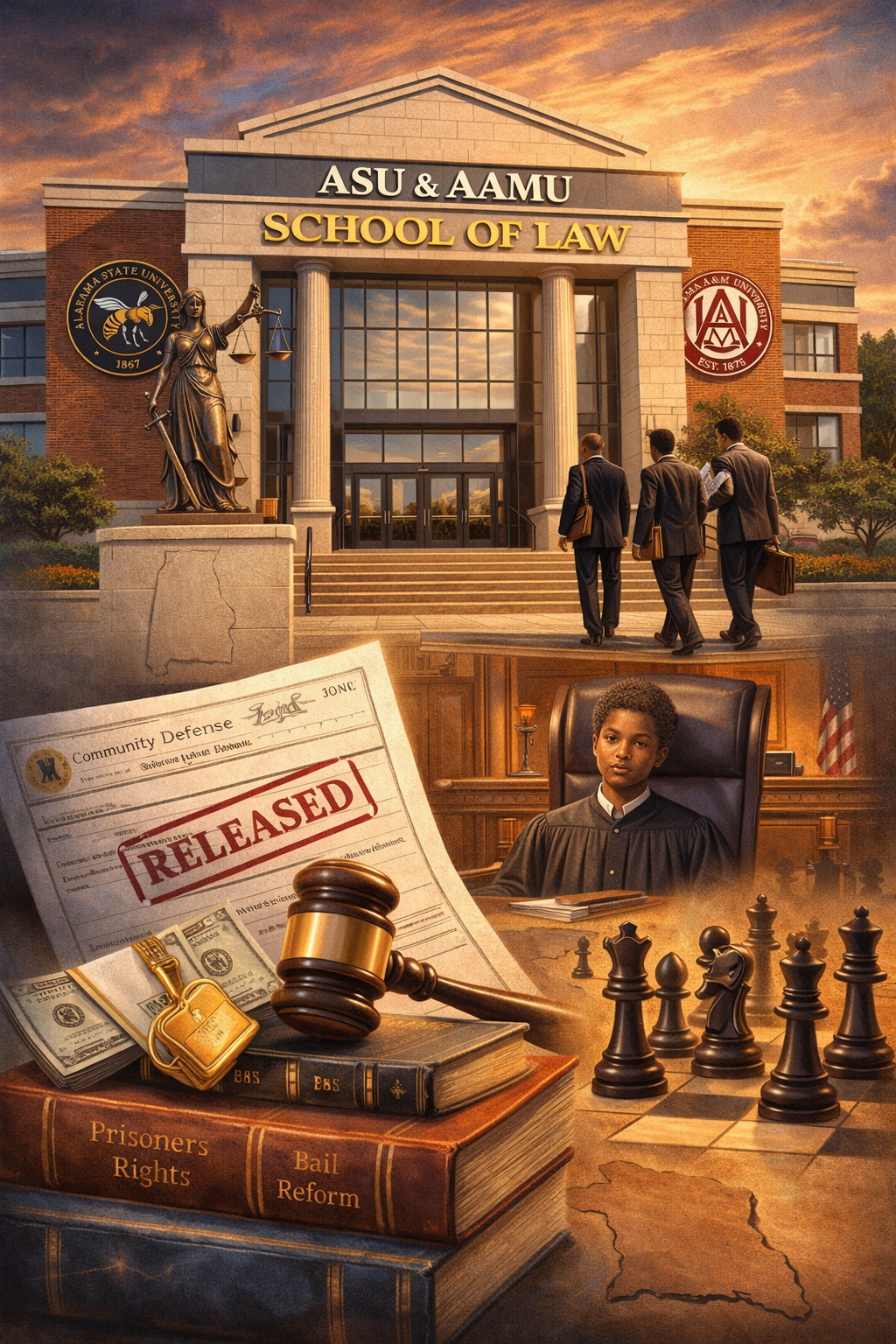
That is not a criticism of those institutions. It is a structural observation about what Black Alabama and by extension, what Black America has been permitted to build or even thought to build. There is no HBCU law school in the state that could anchor a robust legal defense fund for incarcerated Alabamians. There is no institutional pipeline generating Black attorneys who specialize in prison conditions litigation and feel a specific mission-driven obligation to the communities most harmed by Alabama’s corrections system. There is no HBCU-anchored public defender network, no HBCU-rooted judicial pipeline strategy designed to place more Black judges on state and federal benches where these cases are decided. The U.S. Department of Justice filed a lawsuit in 2020 alleging widespread constitutional violations inside Alabama prisons. Alabama’s governor responded by insisting there must be “an Alabama solution” meaning, in practice, that outside accountability would be resisted is the nice polite way to say it. What the documentary cannot show us, because it does not exist, is a Black institutional counter-force: a network of HBCU-affiliated legal scholars, criminal defense attorneys, and movement lawyers who have been preparing for exactly this moment.
Our generation was handed a theory of change that goes something like this: if we document the abuse clearly enough, if we make the evidence undeniable, if we get it on camera, onto HBO, onto the Academy Awards shortlist then the people doing the harm will feel enough shame or face enough pressure to stop. The men inside Alabama’s prisons believed some version of this. They bought contraband cell phones. They filmed overdoses, men nodding out in hallways, the disorder and the violence. They founded the Free Alabama Movement. They organized a work stoppage in 2022. They appealed to the federal government. They did everything the playbook said to do. And the guard who beat Steven Davis to death was promoted. Twice.
Alabama spent $393,000 on eleven separate attorneys to defend the officers named in Sondra Ray’s lawsuit and then paid her $250,000 to settle. The math of that transaction tells you everything about how seriously the state takes the sunlight. This is not a new lesson. It is actually a very old one. Ida B. Wells documented lynching with meticulous journalistic precision and was run out of Memphis for it. The documentation did not stop the lynchings. It built the case — morally, historically, politically — for the work that had to happen in other arenas: legal arenas, legislative arenas, economic arenas. The witness was necessary but never sufficient. Somewhere along the way, we began to treat the witness as the strategy itself. We began to believe that the accumulation of evidence, of footage, of reports, of documentaries, of think pieces would produce accountability on its own. We became very good at producing evidence of harm. We became less focused on building the institutional machinery to convert that evidence into durable change.
The documentary briefly illuminates something important: the incarcerated men at the center of the film credit a self-directed law study group organized by prisoners who had been active in the civil rights movement as the foundation of their resistance. They learned their constitutional rights. They learned how to file grievances. They built an intellectual framework for their activism before they ever picked up a cell phone. That instinct to build institutional knowledge and legal capacity is exactly right. It just needs to operate at a much larger scale, and from the outside.
A genuine defense framework for Black Alabama and for Black communities across the diaspora would look like an HBCU law school in the state, or at minimum a formal legal clinic partnership between Alabama A&M or Alabama State and an existing HBCU law program — Howard, North Carolina Central, Southern University — specifically dedicated to prisoners’ rights and criminal defense. It would look like a Black-led legal defense fund capitalized by Black philanthropists, Black churches, Black fraternal organizations, and HBCUs themselves, oriented specifically toward conditions-of-confinement litigation in Southern states. And critically, that defense fund must include a robust, permanently capitalized bail fund. The crisis documented in The Alabama Solution does not begin at sentencing — it begins at arrest. A significant portion of the people inside Alabama’s jails and prisons on any given day have not been convicted of anything. They are there because they cannot afford bail. They lose their jobs, their housing, and their families while waiting for a trial that may be months or years away. That pretrial detention then becomes a weapon: prosecutors offer plea deals that amount to time served, and people accept them simply to get out — accepting a criminal record they would not have accepted had they been free during the process. Black people are disproportionately trapped in this machinery at every step. A community defense fund that focuses only on post-conviction litigation while leaving people to rot in pretrial detention is fighting the fire from the wrong end. Bail funds are not charity. They are a structural intervention in a system that uses poverty as a substitute for guilt. It would look like a coordinated judicial pipeline strategy: identifying Black lawyers in Alabama, funding their campaigns for judgeships, supporting their appointments to the federal bench, and doing so with the same strategic discipline that conservative legal networks have applied to reshaping the federal judiciary over the past four decades. The Federalist Society did not build its influence by issuing reports about what the other side was doing. It built pipelines. It built institutions. It played a long game. A real defense framework would also include an economic dimension connecting consumer choices to prison labor supply chains in a sustained, coordinated way because the documentary notes that incarcerated Alabamians produce goods that end up at corporations like McDonald’s and Walmart. That leverage exists. It simply requires organized institutional infrastructure that individual documentaries and individual outrage cycles cannot substitute for.
There is a finite amount of energy in any movement. Attention is a resource. Outrage is a resource. The dollars people donate after watching a devastating documentary are a resource. And right now, across the Black diaspora, a disproportionate share of that energy goes toward documentation and reaction — toward describing what is being done to us — rather than toward building the institutions that could materially change conditions.
At some point, all of our energy cannot go toward pointing out what other groups are doing to us while no energy goes toward building defense and offense frameworks. We got suckered, somewhere along the way, into the belief that if we just kept shining a light on the harm, the people causing the harm would eventually stop. Alabama’s prisons — and the documented, filmed, internationally recognized humanitarian catastrophe inside them — are the answer to that theory.
Alabama has fifteen HBCUs. It has a deep bench of Black professionals, Black churches, Black fraternities and sororities, Black civic organizations, and Black philanthropic capacity. All of that exists. None of it has been organized into a sustained, funded, legally anchored defense infrastructure commensurate with the scale of the crisis.
Selma University sits in Selma, Alabama, a city whose name is synonymous with the willingness to absorb violence in the pursuit of justice. Tuskegee carries the legacy of Booker T. Washington’s insistence on building something permanent, something that could not be taken away. Alabama State University exists because Black Alabamians in 1867, in the wreckage of slavery and in the teeth of violent opposition, decided they would build an institution anyway. Miles College in Fairfield. Stillman in Tuscaloosa. Talladega College, the oldest private HBCU in Alabama, founded in 1867 by two formerly enslaved men.
These institutions did not come out of comfortable conditions. They came out of a refusal to accept that witness was the only weapon available. The men who filmed The Alabama Solution from inside those prisons understood the same imperative. They organized study groups. They built movements. They took extraordinary personal risks to create a record the world could not ignore. The question for those of us on the outside is whether we are willing to build the institutional infrastructure worthy of their sacrifice or whether we will keep watching, sharing, and waiting for the light to do what only organized power can do. The Alabama crisis will not be solved by one more documentary. It will be solved if it is solved by lawyers, by judges, by legislators, by organized economic actors, and by institutions with the staying power to sustain a fight across decades. Fifteen HBCUs, and not one law school between them. That is where the work begins.
Alabama State’s motto is “Start the Work.” Alabama A&M’s is “Success — Through Education.” Both institutions exist because people who had far fewer resources than we have today decided that building something permanent was more important than waiting for conditions to improve on their own. The men who filmed The Alabama Solution from inside those prisons understood this instinct too. They organized study groups. They built a movement. They took extraordinary personal risks to create a record that the world could not ignore. The question is whether those of us on the outside are willing to build the institutional infrastructure worthy of their sacrifice or whether we will settle, once again, for watching and sharing and waiting for the light to do what only organized power can do.
The Alabama crisis is not going to be solved by one more documentary. It is going to be solved — if it is solved — by lawyers, by judges, by legislators, by organized economic actors, and by institutions with the capacity to sustain a fight across decades. It is time we started building them.
HBCU Politics covers the intersection of Historically Black Colleges and Universities, political power, and Black civic life.
Disclaimer: This article was assisted by ClaudeAI.
 hbcupolitics