The future lies with those wise political leaders who realize that the great public is interested more in Government than in politics.– Franklin D. Roosevelt
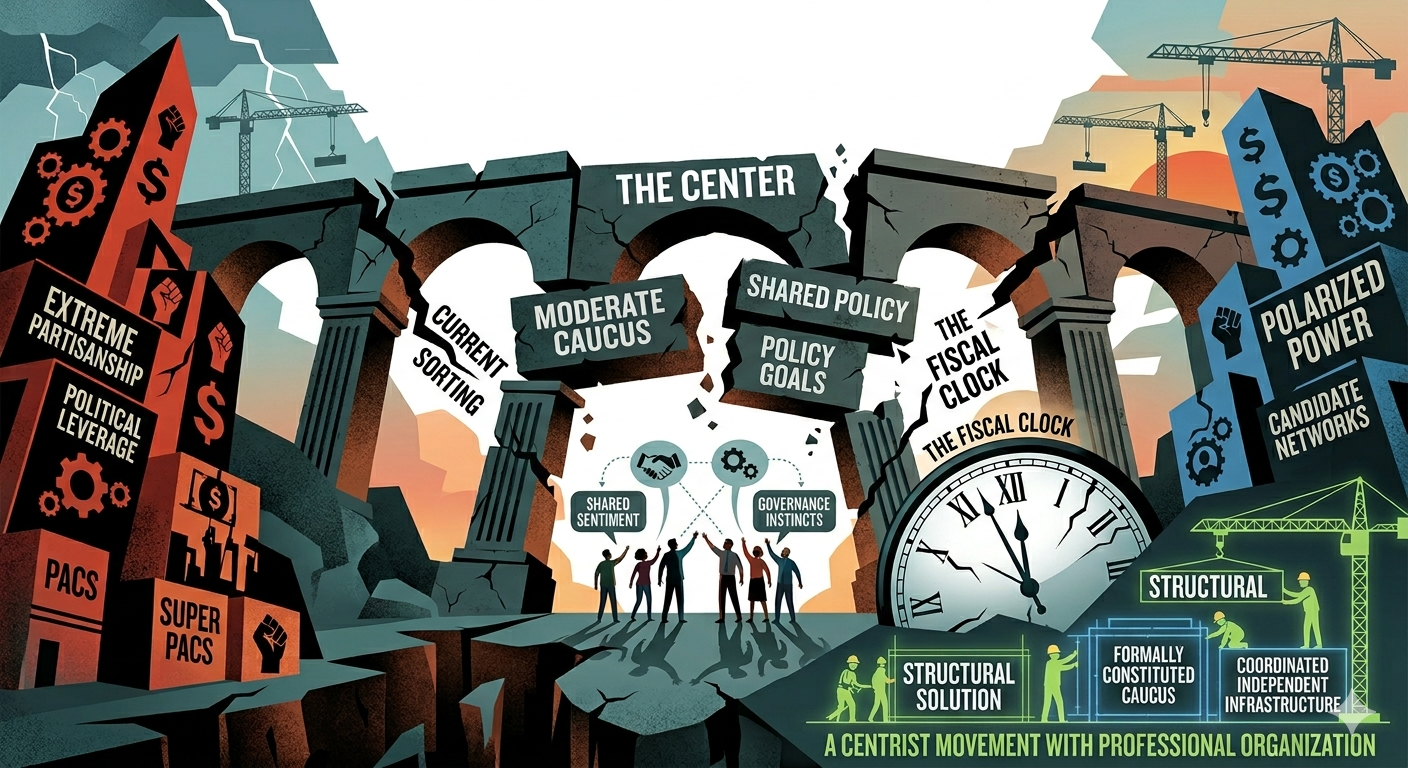
There is a particular kind of political cowardice that does not announce itself as fear. It arrives dressed as pragmatism, as party loyalty, as the calculated silence of officials who know better but choose comfort over consequence. For more than a decade, the moderate wings of both the Democratic and Republican parties have watched the political architecture of the United States fracture and responded with op-eds, luncheons, and quietly murmured concerns that never hardened into institutional action. The result is a republic drifting toward a binary so extreme that governance itself has become secondary to ideological performance. The question facing moderates in both parties is no longer philosophical. It is operational: do they build the institutional infrastructure to compete, or do they continue to cede the field to forces that have no interest in governing a functional country?
This is not an article about ideology. It is an article about institutional capacity, the difference between a political tendency and a political force. Moderates across party lines share more policy common ground than the current sorting of American politics suggests. What they lack is the organizational scaffolding that transforms shared sentiment into coordinated power: the PACs, the Super PACs, the candidate networks, the policy frameworks, and the constitutional mechanism whether a formalized memorandum of understanding between cross-party factions, a genuine third-party vehicle, or a coordinated independent candidacy infrastructure that can translate centrist governance instincts into electoral leverage. Without that infrastructure, moderation remains an attitude, not a movement. And attitudes do not win primaries, fund campaigns, or pass budgets.
The institutional gap is stark. The progressive left has built a dense network of aligned organizations — ActBlue, the Justice Democrats, sundry policy shops — that move money and candidates with disciplined coordination. The populist right has its own ecosystem: the Club for Growth, America First PACs, and media infrastructure that functions as a permanent political operation. Moderates from both parties, despite representing, by most survey evidence, a plurality of the American electorate, have no equivalent structure. The problem is not the absence of moderate voters. It is the absence of moderate institutions.
Consider the fiscal arithmetic the country now faces. The federal debt has crossed $36 trillion. Interest payments on that debt now consume a larger share of the federal budget than defense spending. The Congressional Budget Office projects that absent structural reform, this trajectory becomes self-reinforcing within a decade. Neither the far left nor the populist right has produced a credible response to this reality. The left resists any meaningful constraint on entitlement growth; the right has made large-scale tax cuts its primary legislative instrument even as deficits balloon. The result is a bipartisan fiscal abdication that is, at its core, a governance failure, one that will fall hardest on the populations least equipped to absorb economic shock.
A serious moderate policy platform would start from fiscal honesty. It would acknowledge that the social safety net of programs such as Medicaid, Social Security, nutrition assistance, housing vouchers represents not a political concession but an economic stabilizer, one that prevents poverty from compounding across generations in ways that ultimately cost the state far more than the benefit itself. But it would also acknowledge that these programs require sustainable funding architectures. The compromise that neither extreme will offer is this: a revenue base sufficient to fund a leaner, more efficient, more accountable set of programs including targeted tax increases on a minimum of 30-40 percent of the highest earners and large-scale capital gains, paired with serious administrative reform of program delivery. This is not a radical proposition. It is what responsible center-right and center-left governance looks like in most developed economies. What it requires is the political cover that comes from a coordinated bloc willing to vote together and absorb the attacks from both flanks.
The same framework applies to the small and medium-sized business economy. The ideological battle between trickle-down tax policy and redistributive spending has consistently overlooked the structural importance of businesses that employ between ten and five hundred workers, the segment that generates the majority of net new employment in the United States and that anchors local economies in ways large corporations, with their mobile capital and global supply chains, do not. A serious moderate policy agenda would prioritize capital retention at the local level: tax incentives structured to reward reinvestment within geographic communities, community development financial institution expansion, small business lending reform that reduces dependence on the largest banks, and zoning and permitting reform that lowers the cost of business formation. These are not ideologically charged propositions. They are administrative and fiscal tools that both center-left and center-right legislators could support if they were operating within a framework of shared governance rather than permanent campaign posture.
Women’s reproductive rights represent a harder negotiation, but not an impossible one. The post-Dobbs landscape has produced a patchwork of state laws that have imposed genuine medical harm — not as an ideological claim but as a documented clinical reality, with obstetric care deteriorating in restrictive states and maternal mortality rising in populations with the least access to alternatives. A moderate consensus position, one that establishes federal baseline protections for early-term access while allowing state-level variation beyond that threshold, paired with robust contraceptive access and maternal health investment will not satisfy either ideological extreme. But it reflects where a substantial majority of American voters actually sit on the question, and it is the kind of compromise that a cross-party bloc could defend to its respective electorates as a governance achievement rather than a surrender.
The institutional vehicle for advancing this agenda requires construction, not merely conversation. The most direct path is a formally constituted cross-party caucus that operates with its own financial infrastructure. A Super PAC aligned with this caucus could raise and deploy resources to support moderate primary candidates in both parties not to elect Democrats or Republicans per se, but to populate Congress with members who are institutionally accountable to a governance framework rather than a base activation strategy. The organizational precedent exists: the Problem Solvers Caucus in the House has demonstrated that cross-party collaboration on specific legislative questions is possible. What it has not yet demonstrated is the capacity to function as a genuine electoral force because it lacks the financial and organizational infrastructure to make membership in it more valuable than loyalty to party leadership. That is the gap that needs to be closed.
A second option, the creation of a third party organized around the center, faces the structural reality that American electoral law is designed to disadvantage third parties. Winner-take-all districts, ballot access requirements that vary by state, and the absence of ranked-choice voting at the federal level all create enormous friction for new entrants. But the conditions that make a third party difficult to build do not make it impossible, and they are precisely the conditions that a well-capitalized, institutionally serious effort could address over a decade-long horizon. The Reform Party of the 1990s demonstrated that a sufficiently funded independent candidacy could force the major parties to absorb policy positions they had previously ignored. A Common Good party, organized not around a charismatic individual but around a policy framework and an institutional membership structure, would represent something the American political landscape has not seen in the modern era: a centrist organization with professional infrastructure and a long-term theory of change that does not depend on a single election cycle.
The third option, and perhaps the most immediate, is the formalization of independent candidacy support networks — mechanisms by which sitting moderate legislators who choose to run without party affiliation can access the same financial and organizational resources that party infrastructure currently provides. This would require a Memorandum of Understanding between organized moderate factions specifying shared policy commitments, mutual endorsement protocols, fundraising reciprocity, and common messaging frameworks. It would function less like a party and more like a professional association with electoral teeth. The National Governors Association has long demonstrated that executives across party lines can coordinate on shared governance priorities without collapsing partisan identity entirely. A similar model at the legislative level, backed by dedicated financial infrastructure, is achievable.
None of this is idealism. It is institution-building, the same logic that has governed every successful political realignment in American history. The abolitionist movement did not transform American politics through moral suasion alone; it built newspapers, political clubs, and ultimately a party. The labor movement did not win the New Deal through strikes alone; it built institutional relationships with the Democratic Party that gave it leverage over policy outcomes for decades. The question for moderate Republicans and Democrats in 2026 is not whether they share enough common ground to govern together. They demonstrably do. The question is whether they have the institutional seriousness to stop waiting for conditions to improve and start building the organizations that will determine whether conditions ever do.
The fiscal clock is not ideological. The debt ceiling is not partisan. The erosion of the small business economy does not distinguish between red and blue zip codes. And the political instability that has made the United States a less reliable partner internationally, a less investable environment economically, and a less coherent society institutionally is not a problem that resolves itself. It requires people in positions of institutional responsibility to build something deliberately, capitalized appropriately, structured for durability before the window for doing so closes entirely. History does not reward the moderate who waited for consensus. It rewards the institution that created the conditions for consensus to become possible.
The center is not holding because it is not organized. That is a structural problem with a structural solution. The only question is whether those who understand the stakes will act on that understanding before it is too late to matter.
Disclaimer: This article was assisted by ClaudeAI.
 hbcupolitics