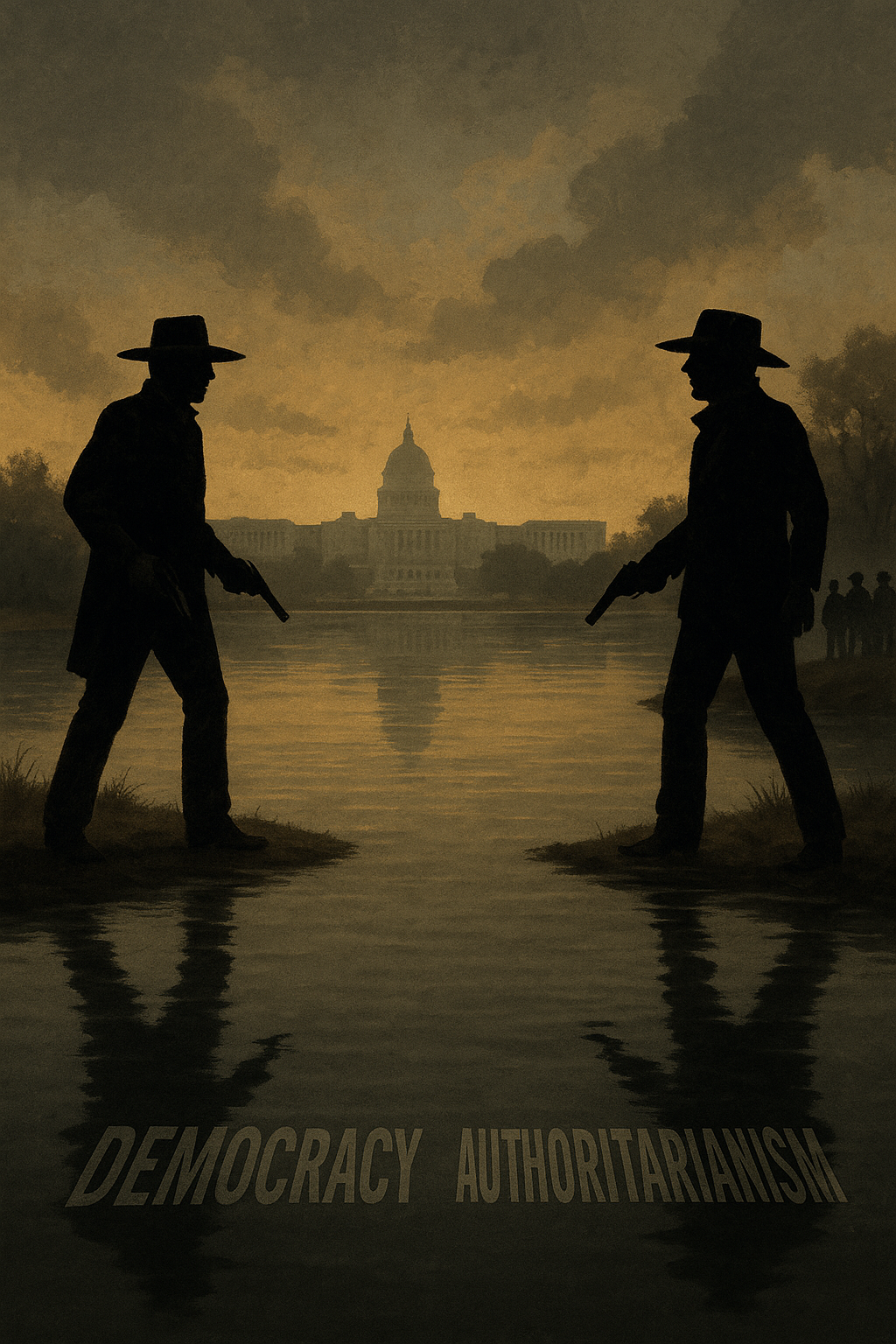
The Western is America’s first political cinema. Long before the comic-book blockbuster dominated box offices, Westerns told the story of America in archetypes—loners seeking justice, towns under siege, ruthless barons, and the eternal tension between law and lawlessness. Sam Raimi’s 1995 The Quick and the Dead, often dismissed in its time, resonates with fresh urgency in the era of Donald Trump. Its themes of power, spectacle, vengeance, and survival eerily mirror the political landscape of Trump’s America, where the duel has replaced deliberation, where the tournament is rigged by the strongman, and where the crowd gathers not for democracy but for blood sport.
At its core, The Quick and the Dead unfolds in the town of Redemption, where Gene Hackman’s John Herod rules through fear. He hosts an annual quick-draw competition not as a celebration of skill but as a ritual of domination. Contestants gather not to build community but to destroy one another for Herod’s entertainment. Power is consolidated, rules are malleable, and survival depends not on institutions but on the will of the tyrant. It is not difficult to see Trump in Herod, nor America in Redemption.
Redemption is a place where institutions have collapsed. There is no functioning government, no rule of law, no communal solidarity. Everything flows through Herod. He sets the rules of the competition, changes them at will, and ensures that no rival grows too powerful. In Trump’s America, the same collapse of institutional guardrails has unfolded. The Department of Justice became a political shield; elections were challenged with reckless abandon; norms of governance were discarded as though they never mattered. Like Herod, Trump relished the performance of power. He staged rallies that resembled gladiator games, where his dominance was cheered and where enemies were mocked, jailed, or metaphorically shot in the public square.
In both Redemption and America, the crowd is complicit. Townspeople in The Quick and the Dead gather gleefully for the duels, treating human life as spectacle. They do not resist Herod; they enable him, celebrating the violence that sustains their own oppression. Trump’s base has functioned in much the same way. The cruelty of immigration policies, the open disdain for the vulnerable, the sneering dismissal of democratic values—these were not hidden but flaunted, and the cheering crowds validated them. The mob at the U.S. Capitol on January 6th was not an aberration but the logical conclusion of a society conditioned to treat politics as blood sport.
Sharon Stone’s Ellen, known only as “The Lady,” enters the tournament as a disruptive force. She is not there for glory or wealth but for revenge. Her father, a marshal, was murdered by Herod, and she seeks justice in the only form the town recognizes: the duel. In Trump’s America, outsiders also enter the stage—whistleblowers, journalists, protestors, women, immigrants, and communities of color. They do not come armed with institutional backing but with determination to resist tyranny, often at great personal cost.
Ellen’s dilemma is the dilemma of American democracy: how do you defeat authoritarianism in a system built to serve the authoritarian? She must submit to Herod’s rules, even as those rules are stacked against her. Similarly, America has been forced to fight Trump within the confines of a political system designed with loopholes that he could exploit: the Electoral College, the Senate filibuster, the presidential pardon. To challenge him often meant legitimizing his game. The question was whether the nation could outmaneuver the strongman without becoming him.
Russell Crowe’s Cort, a reformed outlaw turned preacher, refuses to fight. He represents morality, redemption, and conscience. Yet Herod drags him into the tournament, chaining him to the logic of violence. Cort’s struggle is America’s struggle: can a nation founded on ideals of freedom and equality resist being corrupted by its own violent traditions? The Trump years forced the country into a profound moral crisis. Religious leaders were tested—many failed, embracing Trump as a messianic figure despite his cruelty. Civic leaders were tested—some capitulated, others remained silent, few stood firmly. Like Cort, America has tried to cling to its higher ideals, but the reality of the duel has forced compromises that hollow out moral integrity.
Leonardo DiCaprio’s Kid, who dreams of proving himself as the best gunfighter, mirrors America’s younger generations. Ambitious, energetic, and naive, the Kid believes he can win the tournament by sheer skill. But the contest is not fair, and his fate is sealed by Herod’s manipulation. In America, young people—whether Millennials or Gen Z—enter a political and economic system stacked against them. They inherit climate crisis, crushing student debt, stagnant wages, and the collapse of trust in institutions. Like the Kid, they want to believe the game is winnable, but they discover that the rules are not designed for their success. In The Quick and the Dead, the Kid’s tragic death is a reminder that hope without structural change is fatal.
Gene Hackman’s John Herod is not just a villain; he is a study in authoritarian power. He kills casually, taunts opponents, and ensures that loyalty is rewarded and defiance punished. His charisma is perverse—he commands loyalty through fear but also through the promise of participation in his spectacle. Trump, too, embodies this archetype. He rewards loyalists with positions and pardons, punishes dissenters with ridicule and exclusion, and creates a politics that thrives on humiliation. Both Herod and Trump are not merely leaders; they are ringmasters of political theater where governance is secondary to dominance.
What makes Herod so dangerous is not only his cruelty but his ability to convince the townspeople that there is no alternative. He monopolizes imagination. Similarly, Trump has reshaped American politics such that his presence defines the debate. His supporters see him as savior; his opponents often define themselves in opposition to him. Either way, he sets the terms. Like Herod, Trump ensures that everything revolves around him, reducing politics to a duel in his arena.
The duel tournament in The Quick and the Dead is ostensibly fair: everyone has a gun, everyone gets a chance. But the reality is that Herod controls the conditions. He shifts matchups, coerces participation, and cheats to maintain dominance. This mirrors America’s political system in the Trump era. Voter suppression, gerrymandering, misinformation, and the outsized influence of money in politics all create the illusion of fairness while ensuring that power remains in the hands of the few. Trump’s attempts to overturn the 2020 election, whether by pressuring state officials or inciting insurrection, were simply the most brazen expression of a system already compromised.
The climax of the film comes when Ellen outsmarts Herod, staging her own death to gain an advantage. She finally defeats him, freeing Redemption. Yet her victory is bittersweet. The town is liberated, but the scars remain, and Ellen leaves rather than rebuild. This ending resonates with the fragility of American democracy. Trump was defeated in 2020, but the victory was narrow, the scars deep, and the system still fragile. The forces that empowered him—white supremacy, economic inequality, media spectacle—remain. Ellen’s departure suggests that victory over a strongman is only the beginning; the harder work is rebuilding institutions and communities that can withstand the next authoritarian.
Perhaps the most haunting parallel between The Quick and the Dead and American society is the role of the crowd. Redemption’s citizens never resist Herod until he is defeated by Ellen. They cheer the duels, place bets, and watch passively as their fates are decided by others. In Trump’s America, a similar passivity has prevailed. Millions watch politics as though it is a television show, consuming news for entertainment rather than engagement. The spectacle of Trump, like Herod’s tournament, thrives on an audience that would rather watch than act. The danger is not only the tyrant but the culture of spectatorship that sustains him.
The Quick and the Dead is more than a Western curiosity. It is a parable for America’s current crisis. It shows what happens when institutions collapse, when power becomes spectacle, when morality is compromised, and when the crowd prefers blood sport to democracy. Donald Trump, like John Herod, thrives in such conditions. The challenge for America is whether it can be more than Redemption—a town liberated by an outsider but too weak to save itself.
The film ends with Ellen riding away, leaving the town to find its own future. The question facing America is whether its citizens will remain spectators or finally step into the arena of democracy—not to duel, but to rebuild.
For African America, the lesson is even sharper. Survival in a society where the rules are rigged cannot depend on waiting for an Ellen to ride into town. It demands institution-building, solidarity, and strategy beyond the duel. In the politics of the quick and the dead, the Black community cannot afford to be the crowd. It must be the architects of a new town—one where power is not Herod’s spectacle but the people’s reality.
Disclaimer: This article was assisted by ChatGPT.
 hbcupolitics