You can’t bomb your way to a livable planet. Security without sustainability is a fortress on fire. – Adapted from African Diaspora environmental justice philosophy
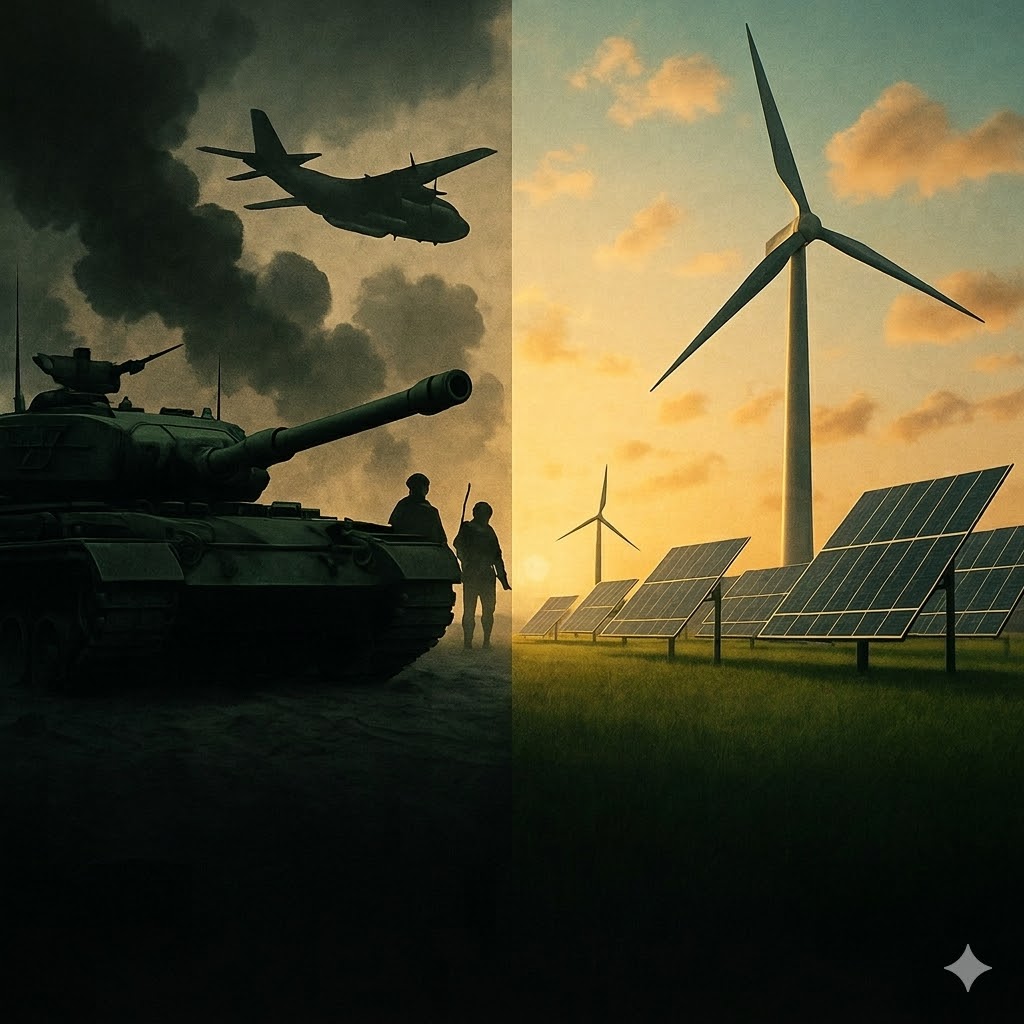
For years, European countries have positioned themselves as standard-bearers for climate justice. They set ambitious carbon neutrality targets, funded renewable energy initiatives across the globe, and carved out diplomatic identities rooted in environmental leadership. Their participation in international climate frameworks was not merely symbolic — it carried financial weight, institutional credibility, and the moral authority of nations willing to restructure their own economies in service of a shared planetary future. But in a geopolitical flash, sparked by Russia’s 2022 invasion of Ukraine and an ever-tense global order, the continent is shifting its focus. The result is an emerging doctrine that prioritizes defense spending over decarbonization, tanks over turbines, and short-term security over long-term survival. For African nations, historically Black colleges and universities, and other Global South stakeholders who depend on European climate leadership and funding, the consequences could be devastating.
The headlines tell a stark story. Germany has launched a one-time €100 billion defense fund. Poland is pushing its military budget to 4% of GDP. France and the United Kingdom are rapidly acquiring advanced weapons systems, while Sweden and Finland are reshaping their long-standing neutrality doctrines. NATO members are now on a warpath to meet — and in some cases exceed — the alliance’s 2% of GDP benchmark for military spending. These decisions carry a certain strategic logic given the current threat landscape. But they also carry trade-offs that rarely make it into the same conversation. Public budgets are not bottomless. Every euro earmarked for air defense systems and cyberwarfare units is one less available for renewable infrastructure, mass transit development, or carbon sequestration initiatives. The European Green Deal — the EU’s cornerstone framework to achieve climate neutrality by 2050 — may now find itself underfunded and undercut by the very governments that championed it.
What makes this shift particularly consequential is that European climate leadership has historically offered the Global South both funding and moral validation. Nations from Senegal to Sri Lanka rely on European aid for clean energy projects, emissions research, and capacity-building in climate resilience. European NGOs frequently lead the policy conversations in international climate diplomacy. Yet as defense budgets swell, those resources are being quietly redirected. In Germany, programs supporting international hydrogen technology partnerships have seen delays. In the United Kingdom, subsidies for homegrown solar initiatives face cuts. Southern European countries, already fiscally stretched, are being forced to choose between national security and international sustainability commitments. For institutions like HBCUs that work in international development, energy access, or agricultural sustainability, this shift is not abstract. Many of their programs are funded through partnerships with European institutions or depend on global frameworks shaped by European diplomacy. If Europe retreats from its climate commitments, it weakens the entire architecture those programs depend on.
The environmental cost of this military turn runs deeper than diverted budgets. Military readiness is one of the most fossil-fuel-intensive activities in modern governance. Fighter jets, tanks, aircraft carriers, and missile systems operate on immense quantities of energy — almost exclusively derived from carbon-heavy fuels. Increased training operations, new procurement cycles, and expanded military exercises will significantly raise national carbon footprints across the continent. What makes this especially troubling is that these emissions are largely invisible within international reporting frameworks. Both the Kyoto Protocol and the Paris Agreement permit the exclusion of military emissions from national carbon accounting. So not only does militarization harm the climate — it does so in ways the official ledgers never capture. The arms industry compounds the problem further. Producing the next generation of drones, tanks, and hypersonic missiles requires vast inputs of raw materials and manufacturing energy. With European countries scaling up military production, their climate commitments are being quietly dismantled, not through public repudiation, but through the slow accumulation of carbon-intensive decisions justified under the banner of national defense.
The reemergence of hard-right nationalism in the United States has intensified this dynamic considerably. The MAGA movement, and the broader political realignment it represents, has reverberated across the Atlantic in ways that complicate Europe’s strategic calculus. With the Republican Party increasingly skeptical of international alliances and climate agreements, European nations have grown uncertain about the reliability of the transatlantic security partnership. Donald Trump’s first presidency was marked by threats to withdraw from NATO, reduced support for global climate accords, and an explicit disdain for multilateralism. His return to power — or the ascent of a like-minded successor — has accelerated Europe’s shift toward military self-reliance. Rather than depending on American security guarantees, European powers are preparing for a future where U.S. support is conditional, unpredictable, or withdrawn entirely. This recalibration has led to aggressive increases in defense budgets, with European capitals prioritizing deterrence and autonomy over cooperative climate diplomacy.
The MAGA doctrine’s proud dismissal of climate science and its preference for fossil fuel dominance also undermines global environmental efforts in ways Europe cannot afford to ignore. If Europe’s climate agenda is to serve as a counterweight to this ideological wave, it cannot afford to dilute its investments in green infrastructure. Yet by reacting to the uncertainties of American politics with militarized reflexes, Europe risks inadvertently aligning itself with the very carbon-heavy path it once sought to reform. The convergence of American political extremism and European defense anxiety is creating a dangerous global drift away from coordinated climate action. Without robust resistance to this trend, the climate crisis risks becoming a secondary concern in a new age of nationalism and rearmament — precisely when urgency demands it be treated as the primary one.
If Europe’s climate leadership falters, the Global South suffers first and worst. African nations depend on climate funding, technology transfer, and equitable trade frameworks to build resilience against a crisis they did not cause. Europe’s environmental retreat could slow the global transition to renewables, delay international climate agreements, and diminish the diplomatic pressure applied to major polluters like China and the United States. The ripple effects extend beyond policy corridors. Institutions across the African diaspora, including HBCUs, have built their models of international engagement around climate justice. Their global partnerships, student exchanges, and joint research programs frequently align with European environmental goals. If those goals become secondary to military strategy, collaboration becomes harder — and so does the broader project of justice that such collaboration serves.
None of this means the pivot to defense must be a pivot away from climate. But doing both requires political will, visionary leadership, and a genuine willingness to redefine what security means in the twenty-first century. Military institutions do not have to be climate criminals. European nations could lead the world in building a sustainable defense sector — electrifying military vehicles, using sustainable aviation fuels, and powering bases with renewable energy. These technologies already exist. They simply need political priority and dedicated funding to reach scale. At the same time, climate programs must be protected with the same intensity as military budgets, secured through legally binding commitments that insulate them from the annual fluctuations of political expediency. In times of crisis, climate action cannot be allowed to become optional.
Europe must also push for international standards that include military emissions in climate reporting. It cannot advocate for transparency and accountability in one breath while shielding one of its most polluting sectors in the next. Civil society — including academic institutions — must demand full accountability and refuse to accept the logic that national security exempts any sector from environmental responsibility. Beyond accountability, Europe has an opportunity to build multilateral frameworks that integrate military and environmental priorities rather than treating them as inherently opposed. NATO and the EU could work together to ensure sustainability is embedded in defense planning rather than sacrificed on the altar of deterrence. Military alliances can adopt shared environmental standards and invest jointly in green technologies that serve both strategic and planetary interests.
In the African American tradition of institution-building, self-defense and self-determination have never been treated as alternatives to community resilience — they have always been understood as dimensions of the same struggle. Howard University, Spelman College, Morehouse, and dozens of other HBCUs were built by people who understood that true security required not just physical safety but economic independence, cultural continuity, and environmental stewardship. Europe would do well to absorb that lesson. Security has never been only about borders and bombs. In a world where climate change represents the most existential threat humanity has ever faced, sustainability is not a luxury that can be deferred until geopolitical tensions ease. It is the foundation on which any durable security must be built.
Europe stands at a crossroads. Its history of climate leadership has offered hope to billions of people who have little political power and fewer resources. Its current trajectory risks trading that moral authority for a narrow and ultimately self-defeating militarized pragmatism. The choices made in the next decade will determine not just the security of the European continent, but the survival prospects of communities far beyond its borders. If Europe chooses tanks over turbines, the whole planet pays the price — and no amount of defense spending will protect any nation from the consequences of a destabilized climate. The question is whether European leaders have the courage and the imagination to hold both obligations at once, or whether the pressures of the moment will cause them to abandon the longer, harder, more important work that the future demands.
Disclaimer: This article was assisted by ClaudeAI.
 HBCU Politics