“We continue to suffer because Other’s do what it is in their best interest and then we also do what it is in their best interest.” – William A. Foster, IV
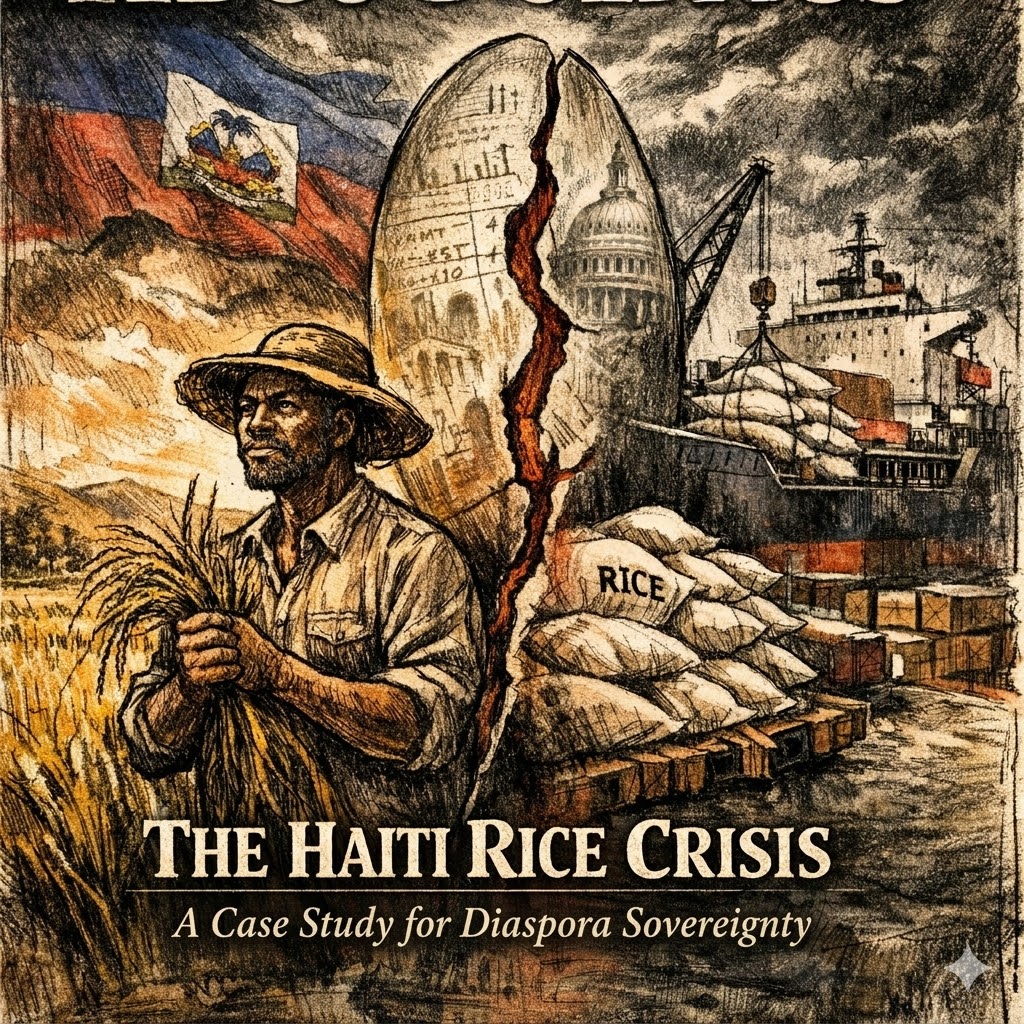
When former President Bill Clinton admitted in 2010 that his administration’s pressure on Haiti to lower rice tariffs in the 1990s had destroyed the country’s agricultural self-sufficiency, the confession was not just about policy failure. It was an acknowledgment that short-term American interests had undermined the long-term economic sovereignty of a majority-Black nation. Clinton said candidly: “It may have been good for some of my farmers in Arkansas, but it has not worked… I have to live every day with the consequences of the lost capacity to produce a rice crop in Haiti.” The phrase “lost capacity” should reverberate deeply within African America and across the African Diaspora. It points to what happens when institutions lack the foresight, strength, and independence to protect their people against global economic pressures.
For African American institutions—HBCUs, banks, foundations, advocacy groups, and political organizations—the story of Haitian rice is not just history. It is a blueprint of how vulnerable a community becomes when its institutions do not command enough power to resist external agendas. As African Americans look toward building global institutions capable of representing Diaspora interests, the Haitian experience offers urgent lessons.
At the heart of Haiti’s rice collapse was a simple economic truth: you cannot feed yourself if you do not grow your own food. Haiti once produced the bulk of its own rice. But after tariffs were slashed under U.S. pressure, subsidized American rice flooded the market. Farmers were ruined, and dependency on imports became structural. Today, Haiti imports the vast majority of its rice, and with recent studies revealing dangerous levels of arsenic and cadmium in American rice shipments, the dependency has become not just economic but existential. For African American institutions, the parallel is clear. Whether it is food, finance, or technology, self-sufficiency is the bedrock of autonomy. An HBCU endowment dependent on corporate donations rather than its own investment engine is vulnerable. An African American bank that leans entirely on government contracts rather than building its own asset base is fragile. A nonprofit that cannot fund its mission without philanthropic gatekeepers will be forced into silence on controversial but necessary issues. Global power begins with internal capacity. Just as nations are measured by their ability to feed their people, institutions are measured by their ability to sustain their communities without begging for permission.
Clinton’s policy, supported by the IMF and World Bank, promised that cheaper rice imports would free up Haitian consumers’ incomes and push workers into industrial jobs. Instead, it decimated rural livelihoods and deepened poverty. Dependency is always sold as efficiency, but in practice it becomes a leash. Haiti’s food security now rises and falls not with Haitian policy but with American subsidies, global shipping rates, and international aid. African American institutions must absorb this truth. A university that depends on federal contracts cannot set a truly independent research agenda for the African Diaspora. A civil rights organization reliant on foundation funding cannot wage global campaigns that might embarrass those very foundations. A global advocacy group for the Diaspora funded primarily through Western NGOs will inevitably find its voice compromised. Institutions must diversify their revenue, build their own endowments, and cultivate internal Diaspora funding streams if they ever hope to be independent actors on the world stage. Otherwise, they will be Haiti—shaped by others, not shaping themselves.
One of Haiti’s structural weaknesses was the fragmentation of its institutions. Agricultural cooperatives, local governments, and national ministries rarely operated in unison. When Clinton and multilateral lenders applied pressure, Haiti lacked a coordinated institutional response. The tariffs fell, the rice poured in, and the institutional guardrails failed to defend the nation’s farmers. African American institutions must not repeat this pattern. Banks, HBCUs, think tanks, and cultural organizations must align their strategies if they are to protect Diaspora interests globally. An African American chamber of commerce cannot promote export industries if African American financial institutions are not prepared to finance them. HBCUs cannot become global research leaders if their alumni and endowments do not coordinate across campuses. The Clinton-Haiti episode demonstrates that when powerful external actors come calling, fragmented institutions are easy to pick apart. Only alignment—an ecosystem of institutions reinforcing one another—creates resilience.
The rationale behind opening Haiti’s rice market was short-term cost savings. Consumers would enjoy cheaper rice. Politicians would avoid price spikes. Arkansas farmers would find a market. But long-term consequences—destroyed rural economies, migration to overcrowded cities, dependency on imports—were ignored. Today, Haiti is still paying for those short-term decisions. African American institutions must cultivate long horizons. A five-year corporate grant may look attractive, but what happens in twenty years when the donor pulls back? A partnership with a foreign university may seem like prestige, but does it build enduring capacity at home? A flashy entertainment-driven initiative may excite headlines, but does it strengthen endowments, ownership, or sovereignty? Global institutions are not built in press cycles; they are built in decades. The Haitian story warns us that short-term benefits can disguise long-term disasters. African American leaders must discipline themselves to plan beyond their own tenure, beyond their own lifetime, toward a horizon of Diaspora power for generations.
Clinton’s apology in 2010 was striking because it revealed what he had always known: his policies benefited Arkansas farmers but harmed Haitian families. He admitted the moral weight of having prioritized domestic politics over Haitian sovereignty. Yet the apology came years too late, after the damage was already entrenched. African American institutions must learn that moral courage in real time is the defining mark of leadership. When offered policies or partnerships that appear lucrative but undermine Diaspora sovereignty, leaders must be prepared to say no. A global African American institution must never become the handmaiden of external power at the expense of Diaspora communities. To defend the community against harm, even when it means losing out on money, access, or prestige, is the true test of an institution’s integrity. Clinton’s hindsight apology is a cautionary tale of what happens when courage is absent at the moment it is needed most.
If African American institutions are to become true global representatives of the Diaspora, they must operationalize these lessons into concrete strategy. That means treating the building of multi-billion-dollar endowments as non-negotiable. It means creating supply chains within the Diaspora so that African America and its allies buy from each other first before turning outward. It requires coordinated governance through Pan-Diaspora councils that align HBCUs, banks, media, and nonprofits around shared goals. It requires generational timelines, planning in 25-, 50-, and 100-year increments, just as corporations and nations do. Above all, it requires ethical non-compromise: the refusal to adopt policies or partnerships that undermine Diaspora sovereignty, no matter how lucrative they appear.
Haiti’s rice dependency is not just a Haitian tragedy. It is a mirror reflecting what can happen to any Black community whose institutions are weak, fragmented, and short-sighted. Haiti was once self-sufficient in food, and in the span of a single generation became dependent on imported grain from its historic oppressor. The same fate can await African American institutions if they do not internalize Haiti’s warning. Imagine, for example, if African American banks surrendered control of their digital infrastructure to foreign fintech companies. Or if HBCUs outsourced entire departments to global universities in exchange for temporary grants. Or if African American cultural organizations allowed corporate sponsors to dictate the limits of their advocacy. The rice story would repeat itself in finance, education, and culture. Dependency breeds vulnerability, and vulnerability invites exploitation.
The future of African American institutions lies in their ability to stand not just as American organizations but as Diaspora institutions. To do so requires not only resources but the discipline to learn from history. Clinton’s rice policy in Haiti is a painful case study of how external forces can reshape Black economies when institutions lack strength. The apology came too late for Haiti’s farmers. But for African America, the time to build sovereign, aligned, courageous, and long-term institutions is now. If African American institutions aspire to represent the Diaspora on the global stage—whether in the halls of the UN, in global markets, or in cultural diplomacy—they must be prepared to defend their people from the fate that befell Haiti. The lesson is clear: no apology can restore lost capacity once it is gone. Only foresight, strategy, and institutional power can ensure that when the world pressures the African Diaspora, its institutions respond not with silence or compromise, but with strength.
Disclaimer: This article was assisted by ChatGPT
 hbcupolitics