“You cannot reason with a tiger when your head is in its mouth” – Winston Churchill’s Darkest Hour*
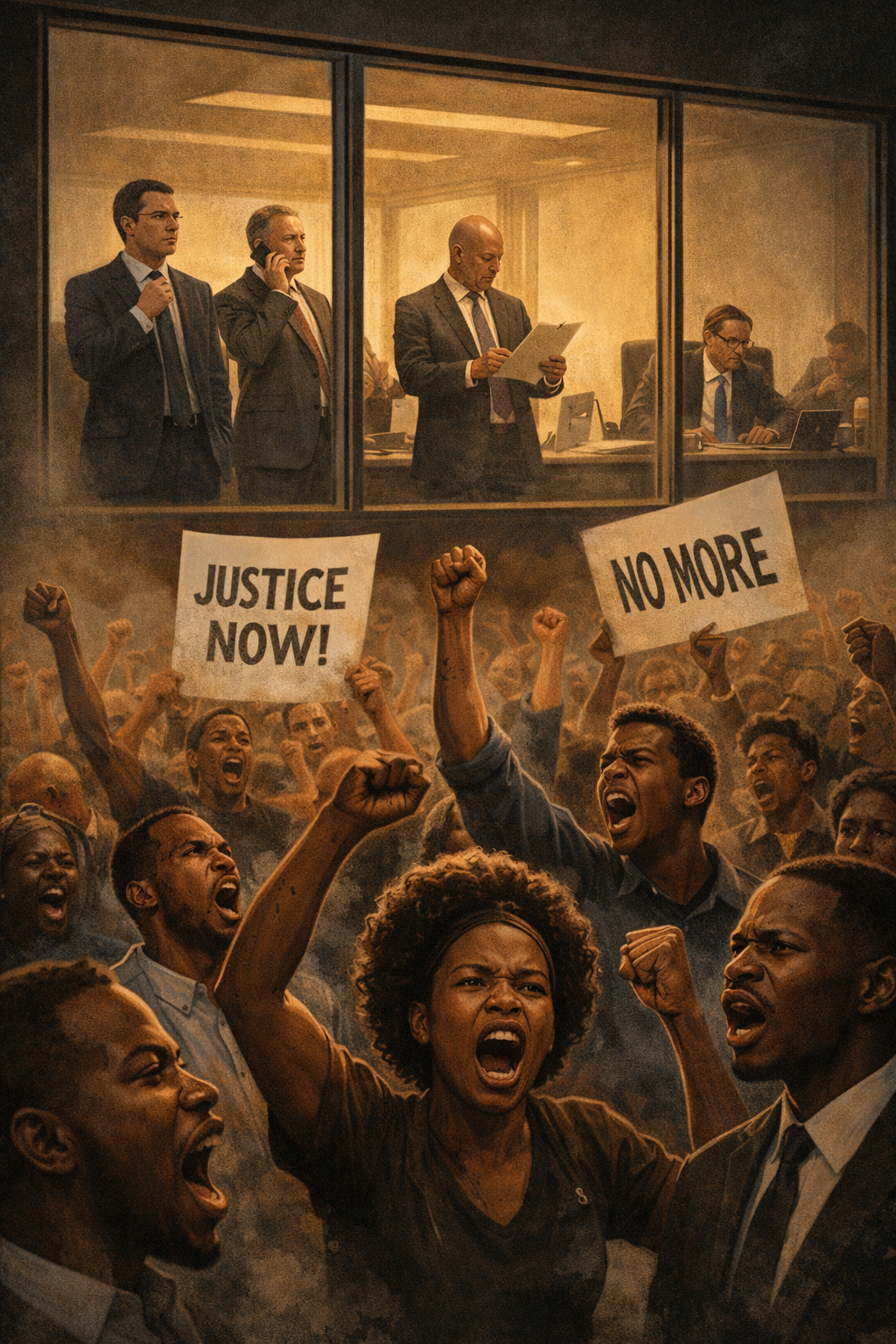
While we debate recognition, others are building empires
Winston Churchill’s metaphor about reasoning with tigers captures a truth that much of Black America and the African Diaspora have yet to fully internalize: power doesn’t negotiate with those it has already consumed. When your head is in the predator’s mouth, appeals to reason, morality, and justice become background noise to the sound of grinding teeth. This isn’t a call to abandon the fight for social justice or equality. Rather, it’s a stark assessment of why that fight, as currently waged, leaves us perpetually vulnerable while other global communities build the instruments of power that make negotiation unnecessary.
Walk through any major American city and observe the divergent approaches to group advancement. In African American neighborhoods, the conversation centers on protest, representation, and recognition. We march for justice. We demand seats at tables we didn’t build. We celebrate when corporations change their logos for Black History Month or when an African face appears in a previously all-white space. Meanwhile, in Koreatown, in Little India, in Chinese enclaves, in Arab business districts, the conversation is different. It’s about capital formation, business networks, educational pipelines, and political leverage through economic power. These communities arrived more recently, often faced their own discrimination, yet approached America with a fundamental understanding: you don’t ask permission to build power; you simply build it.
The contrast is not about culture or capability—African Americans built this country, literally, with enslaved labor that generated the capital for American industrialization. It’s about strategy. We’ve been sold a vision of progress that depends on the oppressor’s recognition rather than our own autonomous power-building. Zoom out to the international stage, and the pattern becomes more troubling. While African nations and the Diaspora seek inclusion in global institutions, other powers are simply creating parallel structures. China doesn’t ask the World Bank for permission it established the Asian Infrastructure Investment Bank. It doesn’t plead for fair trade it creates the Belt and Road Initiative, investing over a trillion dollars across 150 countries, including throughout Africa. Arab nations don’t seek recognition they leverage oil wealth to acquire strategic assets worldwide, from European football clubs to American tech companies to vast agricultural land across the African continent.
Europe, despite its supposed decline, maintains ironclad control over African monetary policy through the CFA franc, used by 14 African nations, a direct continuation of French colonial control that survives because it wields the instrument of monetary sovereignty. When African leaders have attempted to break free, they’ve faced coups, assassinations, and economic warfare. France doesn’t debate African independence; it enforces dependence. Perhaps nowhere is our strategic blindness more evident than in North Africa. We accept without question the term “Middle East and North Africa” (MENA)—a linguistic sleight of hand that cleaves the continent in two. Egypt, birthplace of one of humanity’s greatest civilizations, gets casually reassigned to the “Middle East” in popular discourse, as if the Sahara were an ocean rather than a desert that African peoples have crossed for millennia.
This isn’t ancient history it’s ongoing conquest. Arab expansion into North Africa, which began in earnest in the 7th century, continues today through cultural hegemony, religious conversion, and economic integration that ties North African nations more closely to the Arab world than to sub-Saharan Africa. The original Berber and other indigenous North African populations have been so thoroughly absorbed that suggesting Egypt is an African nation rather than an Arab one provokes puzzlement, even among Africans. Yet where is the Pan-African movement demanding recognition of this conquest? Where are the reparations discussions for the Arab slave trade, which lasted longer and in many regions was more brutal than the Atlantic trade? Where is the pushback against the linguistic and cultural erasure? We don’t even fight these battles because we’re still asking for recognition of more recent injustices, still trying to reason with the tiger.
The numbers tell a sobering story. Black Americans, despite being 13% of the U.S. population with roughly $1.6 trillion in annual spending power, own less than 2% of American businesses. We have the economic power of a mid-sized European nation but virtually none of the institutional infrastructure that would leverage that power. African nations collectively possess some of the world’s richest natural resources—cobalt for batteries, rare earth metals for electronics, vast arable land, enormous renewable energy potential yet remain among the poorest nations by GDP per capita. The resources flow out; the profits accumulate elsewhere. Compare this to how other groups leverage collective economic power. Jewish Americans, roughly 2% of the population, have built formidable economic and political networks that translate community interests into national policy. Asian Americans, fragmented across many national origins, still demonstrate higher rates of business ownership and have built ethnic banking systems and investment networks that keep capital circulating within communities. These disparities aren’t about individual ability—African excellence exists in every field. They’re about collective strategy and institutional building.
Social justice movements have achieved real gains. Civil rights legislation dismantled legal segregation. Black Lives Matter forced national conversations about policing. These victories matter. But victories that depend on appealing to the conscience of the powerful are inherently unstable. What one administration grants, another can revoke. What one court affirms, another can overturn. We’ve seen this cycle repeatedly: progress, backlash, erosion, renewed struggle. Meanwhile, power built on economic control, institutional ownership, and political leverage doesn’t require anyone’s permission to exist. It simply is. When you own the banks, you don’t protest for loans. When you own the businesses, you don’t march for jobs. When you own the media, you don’t ask for representation.
This isn’t to romanticize capitalism or suggest that economic power alone solves everything. Rather, it’s recognizing that every successful liberation movement in history combined moral claims with material power. The American Revolution wasn’t won by appealing to King George’s better nature. Indian independence required both Gandhi’s moral authority and the economic unsustainability of the British Raj. The civil rights movement succeeded in part because Southern segregation became economically untenable. Watch how Asia is reconfiguring global power, and the lessons become clear. China didn’t integrate into the Western-dominated order and hope for fair treatment. It built its own industrial base, created its own technological ecosystem, established its own financial institutions, and now extends its own vision of global order through economic rather and is now building its military means. India, despite enormous internal challenges, leverages its massive market and technological talent to command respect on the world stage. Southeast Asian nations form blocs—ASEAN—that allow smaller countries to negotiate with great powers from positions of collective strength. The common thread: these regions stopped asking for permission and started building power.
Real power in the 21st century means economic sovereignty and control over capital, resources, and the means of production, the ability to finance your own development rather than depending on foreign aid or loans with strings attached. It means institutional infrastructure: banks, investment funds, businesses, media organizations, educational institutions the architecture that allows a community to reproduce and expand its power across generations. Political leverage matters, not just voting, but the ability to make politicians compete for your support through organized economic and social pressure, understanding that power concedes nothing without a demand, and demands require leverage. Cultural production gives you the ability to tell your own stories, define your own image, and export your culture on your own terms not asking for representation but creating the platforms that make asking unnecessary. And strategic thinking that spans generations, not just election cycles or protest movements, with the patience to build foundations before expecting structures.
This assessment may sound grim, even defeatist. It’s neither. It’s a call for strategic reorientation. The quest for social justice and equality remains morally right and politically necessary. But it cannot be our only strategy, not even our primary one. We need parallel tracks: continuing to fight for fair treatment while simultaneously building the power that makes mistreatment costly. This means redirecting some of the enormous energy that goes into protests and consciousness-raising toward institution building. It means treating economic development with the same urgency we bring to social movements. It means thinking like chess players rather than checkers players considering moves several turns ahead, building positions of strength before launching attacks.
It means learning from those who arrived with nothing and built everything. Not imitating them exactly as our history and circumstances differ but absorbing the core lesson: power isn’t granted, it’s taken. Through any means necessary and through the patient accumulation of resources, institutions, and leverage. Churchill’s metaphor remains apt. When your head is in the tiger’s mouth, reasoning is futile. But the metaphor isn’t complete. The real question is: how did your head get in the tiger’s mouth, and how do you extract it? The answer isn’t more eloquent appeals to the tiger’s better nature. It’s building the strength to force open those jaws, and then building walls high enough that tigers think twice before approaching.
Other global communities understand this. They’re not debating whether they deserve equality they’re building the power that makes the question irrelevant. Asia rises not by asking permission but by creating facts on the ground. Arabs expand not through moral arguments but through economic and cultural penetration. Europe maintains control not through persuasion but through institutional leverage. African America and the broader African Diaspora possess the talent, the numbers, the history, and the resources to do likewise. What we’ve lacked is the strategic focus to translate those assets into institutional power. We’ve been taught to seek justice when we should be building power. To demand recognition when we should be creating undeniable facts.
The choice is ours: continue reasoning with the tiger, or start building our own strength. Justice may be our goal, but power must be our method. Because in a world of tigers, the ones with the sharpest teeth don’t need to explain why they deserve to eat. They simply do.
Disclaimer: This article was assisted by ClaudeAI.
*While Churchill did say things like “Dictators ride to and fro on tigers from which they dare not dismount,” the specific phrase about the head in the mouth was created for the movie script but captures his real wartime sentiment.
 hbcupolitics