“The tools of conquest do not necessarily come with bombs and explosions and fallout. There are weapons that are simply thoughts, attitudes, prejudices—to be found only in the minds of men.” – Rod Serling
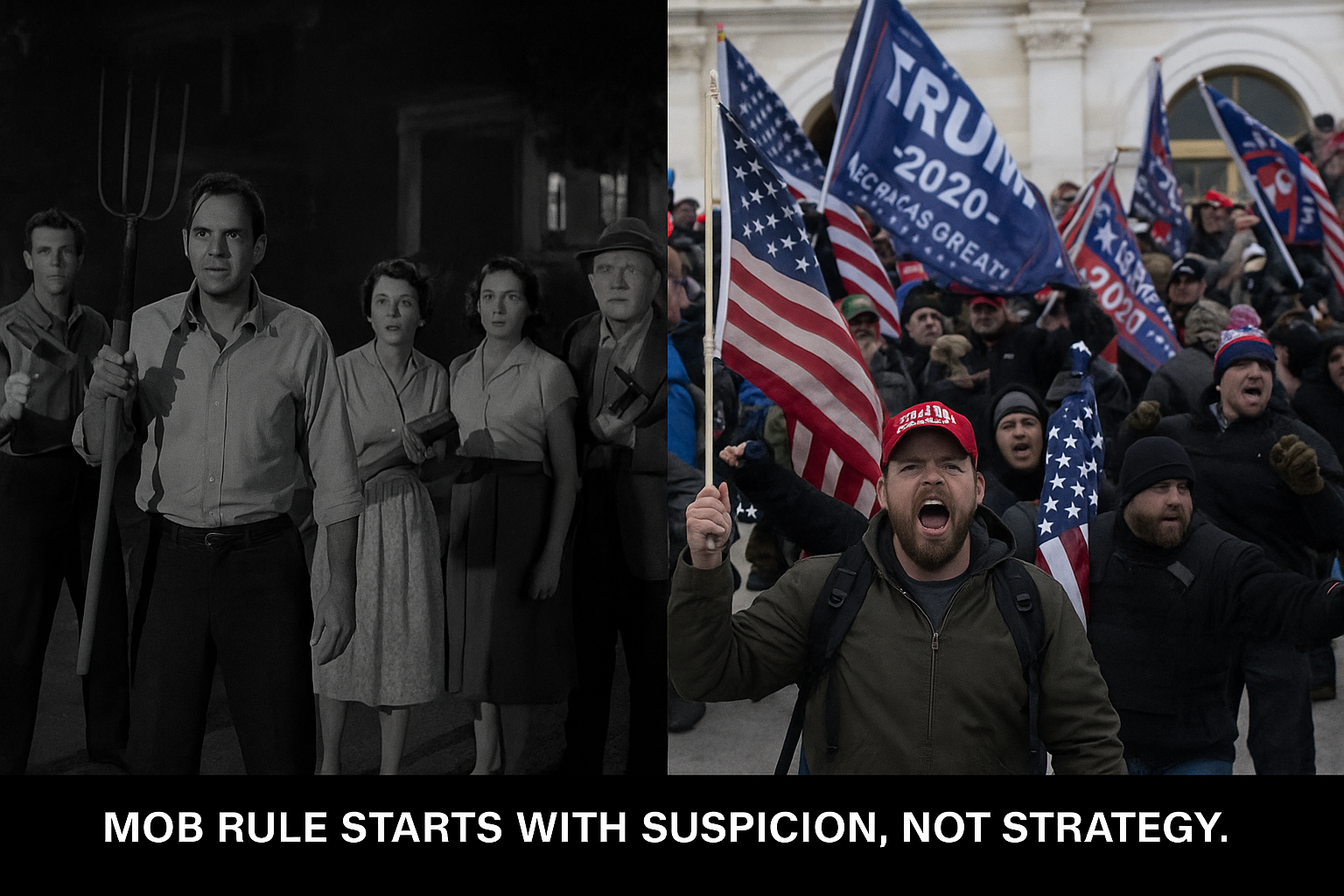
On a quiet street lined with trimmed hedges, front porch swings, and picket fences, an unseen disruption flickers the power. The neighbors step outside, suspicious eyes scanning one another for answers. Whispers turn to accusations. Accusations turn to torches. Chaos erupts. A peaceful community self-immolates—not from invasion, but from its own fear. This is not just The Monsters Are Due on Maple Street, Rod Serling’s prophetic 1960 episode of The Twilight Zone. It is also America in the age of MAGA. While Donald Trump’s “Make America Great Again” movement claims to hearken back to a mythical era of order and prosperity, its rise has mirrored Maple Street’s unraveling: a normal community fractured by paranoia, conspiracies, scapegoating, and ultimately violence—all sparked not by an external threat, but by the story they told themselves about one.
In Maple Street, a young boy’s sci-fi-fueled fear of aliens hiding among them lights the match. In MAGA’s America, the aliens became immigrants, Muslims, the Deep State, or Antifa—depending on the day. It was never about a singular threat but the idea that someone, somewhere, had betrayed the “real” America. Trump did not invent this strategy; he merely mastered its performance. Rod Serling’s aliens never fire a weapon. They simply tamper with the electricity, then sit back and watch. “They pick the most dangerous enemy they can find,” the alien observer says of humans. “And it’s themselves.” Substitute the power outage with a tweet, a false flag accusation, or a QAnon post, and the result is eerily similar. January 6 was just the crescendo of a symphony composed in whispers and fear. Trump’s brand of politics did not need formal laws to be dangerous—it needed only a story. One of stolen elections, sinister forces, and a golden past stripped away. Serling understood this type of narrative long before Twitter made it viral. He recognized that when the people are given fear, they will willingly hand over their logic and compassion.
Maple Street is every small town or suburb that MAGA seeks to reclaim. But this reclamation comes with a price: a constant need to root out “others” from within. What happens when your neighbor votes differently? When your daughter brings home a boyfriend who speaks Spanish? When your church invites a Black preacher to guest speak? MAGA America, like Maple Street, cannot function without paranoia. To be vigilant is to be virtuous. To trust is to be weak. Steve Brand, the voice of reason in the episode, who pleads for calm, is quickly labeled suspect. In MAGA, those who call for nuance or moderation are accused of being RINOs or “woke.” Truth becomes treason. The political street becomes the cultural street. School boards erupt into chaos. Book bans target stories about slavery and civil rights. Public libraries are accused of grooming children. An entire movement is sustained by the question: “Who doesn’t belong here?” And that is the question at the heart of Maple Street. Who is the alien? Who is pretending to be one of us?
Serling, a white liberal from upstate New York, crafted Maple Street during the height of the Red Scare but its subtext is racial as much as political. Every Black family who has moved into a white neighborhood knows the invisible outage: streetlights stop working, neighbors stop speaking, the lawn gets cited for mysterious infractions. Serling’s choice not to specify the “difference” that makes someone suspect other than mere deviation from conformity only sharpens the racial relevance. In Trump’s America, this paranoia became overt. Black Lives Matter was cast as a terrorist group. Critical Race Theory became the monster hiding in textbooks. Even HBCUs, long marginalized, saw their bomb threats go unpunished, their students surveilled, and their missions questioned—all part of a larger fear that Black excellence is inherently subversive to white nostalgia. Trump’s appeal was never truly about economics. It was about grievance. The idea that someone urban, brown, female, queer, non-Christian—had taken something from you. Like Tommy in Maple Street, MAGA’s believers point toward “the different one” and say: “Maybe it’s them.”
To MAGA, Black progress is not just a challenge—it is betrayal.
In Serling’s tale, when the power goes out, logic does too. Flashlights become weapons. Differences become damning. In 21st-century America, the power outage is metaphorical. It’s an algorithm that suppresses truth and amplifies rage. A feed that scrolls endlessly, tightening ideological echo chambers. Just as Maple Street’s residents turn on one another in the absence of information, MAGA thrives in the vacuum created by distrust in media, science, and institutions. The neighborhood no longer needs a boy to introduce a conspiracy. It has Facebook groups and Telegram channels for that. Moreover, the speed of digital acceleration has outpaced society’s ability to apply discernment. One misleading meme, one out-of-context video, one anonymous Reddit post and a mob is born. Truth doesn’t need to be disproved anymore. It only needs to be doubted. The MAGA movement understands that doubt is the new weapon. And in this context, everyone is a suspect election workers, doctors, teachers, and even military officers. Just as Maple Street’s people tore apart their own community in search of invisible aliens, MAGA adherents have turned on democracy itself in search of invisible fraud.
The erosion of community is the most devastating parallel between Maple Street and MAGA. What begins as cohesion ends in division. The collapse is internal, intimate, and total. There was no foreign invasion in Maple Street. No bombs dropped. No armies marched. Instead, trust failed. Empathy vanished. And in their place stood suspicion violent, irrational, and irreversible. This is precisely how MAGAism functions: through erosion, not explosion. Family gatherings split over political rants. Marriages strain. Churches fracture. The workplace becomes a minefield. MAGA does not need a civil war in the traditional sense. It achieves its aims through slow-motion social fragmentation. By the end of the episode, the street is no longer a neighborhood. It is a battlefield. And in much of America today, that metaphor is no longer metaphorical.
In Maple Street, people wrap themselves in the guise of community protectors. They believe they are saving something. The same is true for MAGA. The red hat is not just a slogan it is a symbol of reclaimed dominance. A uniform for those who see themselves as defenders of a way of life under siege. But like the vigilantes in Maple Street, these defenders often have no plan, only panic. Their patriotism is performative, reactive, and combustible. When people attacked the Capitol on January 6 with flags in one hand and zip ties in the other, they mirrored the mob with pitchforks on Maple Street. They were not marching toward the enemy. They were looking in the mirror.
Rod Serling’s The Monsters Are Due on Maple Street did not emerge from a vacuum. It was conceived during one of the most paranoid chapters in American political life: McCarthyism. From 1950 to 1954, Senator Joseph McCarthy led a crusade against alleged communists in the U.S. government and entertainment industry. Careers were ruined, loyalty oaths demanded, and truth became irrelevant. The Cold War hardened this atmosphere. By the time the Berlin Wall went up in 1961, American civic culture was already encased in the logic of “us versus them.” Serling, a WWII veteran, saw clearly what paranoia does not just to foreign policy, but to the soul of a nation. Post-9/11 America repeated the pattern. The Patriot Act loosened restrictions on privacy and due process. Muslims were profiled. Sikhs were assaulted. The “enemy within” reemerged not wearing a hammer and sickle, but a keffiyeh. In all three moments—McCarthyism, the War on Terror, and MAGA paranoia was not a byproduct. It was policy. It was weaponized to demand conformity, stifle dissent, and reassert control.
If Maple Street were written today, it would not feature a single boy triggering the town’s collapse. It would star an algorithm. Cable news, social media platforms, and partisan sites operate not as public squares, but as pressure chambers. Fox News fuels grievance. MSNBC fuels resistance. Truth becomes tribal. Social media disintermediates everything. A meme with a false claim can reach millions in minutes. Machine learning ensures users are served content that inflames fear. Belief is no longer about evidence it’s about identity. Rod Serling warned that thought itself can be a weapon. Today, that weapon is monetized. The monsters aren’t watching quietly. They’re programming the feed.
The cost of American paranoia has been disproportionately paid by African American institutions. From COINTELPRO to present-day bomb threats at HBCUs, strength is often recast as danger. HBCUs, churches, civic groups—all face surveillance and distortion. Media narratives frame assertion as aggression. Grantmakers hesitate. Law enforcement monitors. A climate of fear is cultivated and internalized. MAGA does not need to dismantle Black institutions directly. It only needs to whisper, “Watch them,” and let society take it from there. Without strong narrative infrastructure, these institutions are left to defend themselves in hostile public discourse.
Rod Serling left Maple Street in ruins to warn that moral collapse is irreversible if not confronted early. The response lies in:
- Media Literacy: Teaching how algorithms manipulate belief.
- Durable Civic Spaces: Where trust and dialogue are rebuilt.
- Black Institutional Narrative Infrastructure: Media, polling, research, and public engagement tools.
- Rehumanizing the Neighbor: Democracy’s greatest defense is still compassion.
MAGA celebrates the self over society. Its opponents must champion imagination, empathy, and strategy.
Serling’s monsters never landed on Maple Street. They were not needed. The people brought the monsters themselves—in their doubts, their divisions, and their belief that fear was safety. MAGA does not need to take over America to break it. It only needs to whisper loud enough that we begin to break each other.
As Serling warned:
“There are weapons that are simply thoughts, attitudes, prejudices—to be found only in the minds of men.”
It is time we disarm.
Disclaimer: This article was assisted by ChatGPT.
 hbcupolitics