“The trouble with the world is that the stupid are cocksure and the intelligent are full of doubt.” – Bertrand Russell
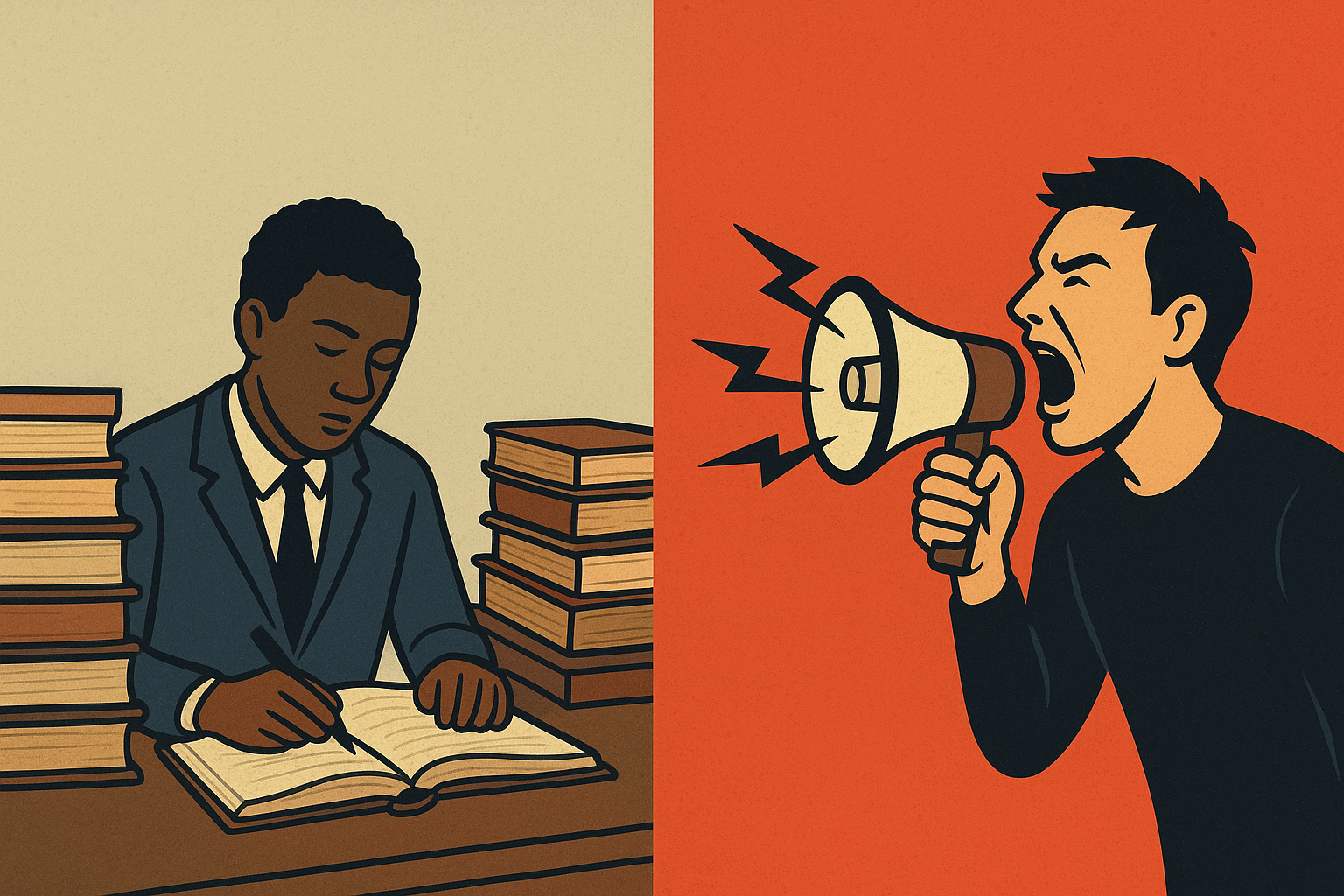
There was a time in America when the credential of an expert carried the weight of authority. A medical doctor’s diagnosis could calm a family. An engineer’s calculations could settle debates about infrastructure. A historian’s research could shape the way a nation remembered its past. In that era, the learned voice held not just intellectual credibility but also cultural respect. But in today’s America, expertise has been pushed into the shadows, replaced by a cacophony of opinions that are uninformed, unexamined, and too often uneducated and dominate political discourse, public decision-making, and cultural life. Loud and wrong has become the new currency of legitimacy. Quiet and learned is dismissed as elitist, irrelevant, or even suspicious. The consequences of this cultural shift extend far beyond frustration for academics, policymakers, and professionals. They threaten the very foundation of a democratic society that once relied on reasoned debate and evidence-based decision-making. For African America and its institutional ecosystem, the stakes are particularly high. When expertise is dismissed, those communities with fewer institutional resources are forced into a double bind of being disenfranchised by both systemic inequities and a culture that no longer respects the informed voices they painstakingly cultivate.
America’s founding was deeply tied to Enlightenment values. The architects of the Republic were immersed in the works of Locke, Montesquieu, and Smith. They valued reason, science, and structured debate, even if they fell short in practice when it came to race, gender, and class. The Founders built institutions like universities, libraries, and learned societies precisely because they believed expertise mattered in building a sustainable republic. Fast forward two and a half centuries and the pendulum has swung toward entertainment as the dominant form of legitimacy. In politics, the most successful figures are often those who master performance rather than policy. A quip on social media carries more political currency than a 30-page policy paper. In culture, celebrity opinion routinely eclipses scholarly research. In economics, meme stocks and viral influencers command more attention than seasoned analysts. This shift has been accelerated by technology, particularly the democratization of publishing through social media. Theoretically, platforms like Twitter, YouTube, and TikTok gave everyone a voice—a noble idea in the abstract. But in practice, this flattening of communication has meant that the virologist who spent 25 years studying coronaviruses competes for legitimacy with a conspiracy theorist armed with memes and anger. Expertise has not simply been devalued it has been ridiculed, mocked, and delegitimized.
The consequences of this preference for opinion over evidence were made painfully clear during the COVID-19 pandemic. Despite decades of research and a global community of public health experts, vast swaths of Americans rejected vaccines, masks, and basic preventive measures. Instead, they embraced internet rumors, anecdotal evidence, and politically charged rhetoric. The cost: hundreds of thousands of preventable deaths, billions in economic disruption, and a national psyche fractured along epistemological lines. But the pandemic was merely a vivid example of a longer trend. Climate science has been attacked for decades, not because the science is weak, but because political and economic actors benefit from casting doubt. Economists who warn about national debt or wealth inequality are ignored in favor of pundits offering comforting soundbites. Historians who document systemic racism face not just dismissal but active hostility, with entire state legislatures trying to ban their work from classrooms. At its root, this is a cultural preference for comfort over truth. Evidence is often complex, nuanced, and inconvenient. Opinion, particularly uninformed opinion, is easy to digest and emotionally satisfying. It allows individuals to cling to their worldview without the discomfort of cognitive dissonance.
Why does loudness now trump learning? The answer lies partly in the economics of attention. The digital age rewards what garners clicks, likes, and shares. Outrage travels faster than reason. Noise drowns out nuance. Loudness becomes a form of currency in itself, allowing individuals with little to no expertise to amass enormous followings and, in turn, political or economic power. This phenomenon is not new. Demagogues have always leveraged volume and charisma to sway crowds. But in the past, institutions like newspapers, universities, and political parties acted as gatekeepers, filtering the loud from the learned. Today those filters have eroded, replaced by algorithms that actively promote content most likely to provoke reaction. The result is a marketplace of ideas in which the price of entry is not knowledge but audacity. For communities of color, particularly African Americans, the loudness premium presents a dangerous paradox. On one hand, the democratization of platforms has given marginalized voices access to audiences once unimaginable. On the other, it has created a battlefield where careful, researched argument is drowned out by those who distort, distract, or destroy for personal gain.
The erosion of respect for expertise hits African American institutions harder than most. HBCUs, think tanks, and policy organizations within the African American ecosystem already struggle against underfunding and underrepresentation. When their experts whether in public health, economics, or history and speak to the nation, they often do so without the megaphones available to their White counterparts. In a society that values volume over validity, the quieter, evidence-driven voice of an HBCU researcher is at constant risk of being overlooked. This creates a feedback loop: African American institutions produce expertise, but society undervalues it. Policymakers then make decisions without incorporating those insights, perpetuating inequities. And when outcomes worsen, the blame often falls on the very communities whose experts were ignored in the first place. The irony is that African American institutions, perhaps more than any other, understand the consequences of ignoring expertise. Generations of Black doctors, lawyers, economists, and educators have carried the burden of proving what should be self-evident—that education and expertise are tools of empowerment and liberation. Yet, as America drifts further from valuing knowledge, those hard-won lessons risk being cast aside.
One of the most disturbing features of this cultural shift is the way anti-intellectualism has become an identity marker. In many communities, rejecting expertise is not simply a matter of ignorance but a badge of authenticity. To be “real” is to reject the “elite,” even if that elite is composed of individuals from the same community who have pursued higher education. This dynamic is particularly damaging in African America, where institutions like HBCUs have historically been the backbone of intellectual life. When African Americans adopt the broader American disdain for expertise, they undermine their own institutions and leaders. The rejection of “book learning” becomes self-sabotage, weakening the very structures designed to uplift the community. It also opens the door for outside manipulation. When people are trained to dismiss their own experts, they become susceptible to external voices who may not have their best interests at heart. This is not simply an academic issue, it is a matter of survival and sovereignty.
What happens to a society that dismisses expertise? History offers grim answers. Civilizations that failed to listen to their engineers crumbled under failing infrastructure. Nations that ignored their economists plunged into financial ruin. Empires that silenced their historians repeated the same mistakes until collapse. For America, the cost is already visible. Infrastructure is deteriorating while engineers’ warnings go unheeded. Wealth inequality continues to widen as economists’ models are dismissed. Public trust in institutions erodes as conspiracy theories replace journalism. The country risks becoming ungovernable, not because of external enemies, but because it cannot agree on basic truths. For African American institutions, the cost is even steeper. Every time an HBCU scholar is ignored in favor of a celebrity’s opinion, every time a Black economist’s research is sidelined for a pundit’s talking point, the community loses an opportunity to shape policy in its favor. The result is a structural disenfranchisement that compounds historical inequities.
The path forward requires a cultural recalibration. Americans must once again learn to distinguish between opinion and expertise, between noise and knowledge. This is not an argument against free speech because every citizen has the right to their opinion. But not every opinion has equal weight in shaping public policy, medical practice, or historical understanding. African American institutions have a critical role to play in this recalibration. HBCUs, research centers, and policy think tanks must continue to assert their expertise with confidence, even in the face of hostility or indifference. They must also innovate in how they communicate, understanding that the loudness premium cannot be ignored but can be strategically harnessed. Being loud does not have to mean being wrong. At the same time, these institutions must cultivate internal resilience against anti-intellectualism within the community. This means affirming the value of education, celebrating the work of scholars, and teaching younger generations that knowledge is power not just in rhetoric but in practice.
America stands at a crossroads. One path leads deeper into the wilderness of opinion, where the loudest voice wins and the consequences are borne by all. The other path requires a return to valuing expertise, to respecting the quiet voices of those who have dedicated their lives to learning, research, and truth. For African America, the stakes are existential. Expertise is not simply a matter of prestige but of power. The power to shape policy, to protect communities, and to secure a future on our own terms. If America refuses to value expertise, African American institutions must value it even more fiercely. In a world where loud and wrong has become the norm, quiet and learned must become not just respected but weaponized. For without expertise, freedom itself becomes fragile.
Disclaimer: This article was assisted by ChatGPT.
 hbcupolitics