“The liberation of one Black nation is the responsibility of all Black people, for we are not scattered—we are connected by struggle, by memory, and by destiny.” — Anonymous Pan-African Proverb, adapted for modern solidarity
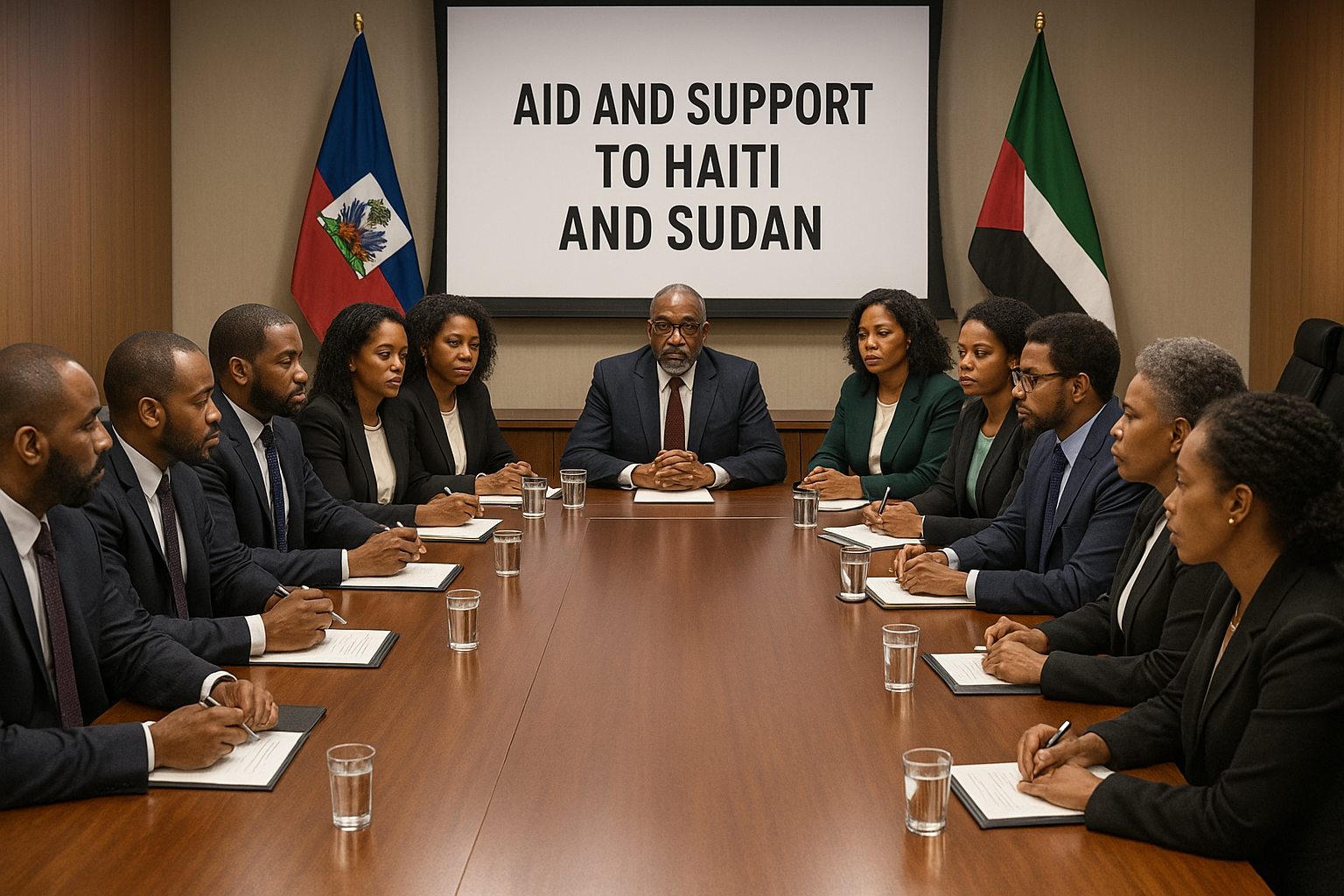
In a world marred by cycles of political instability, economic strangulation, and the calculated abandonment of Black nations by the global order, two countries Sudan and Haiti, stand as emblematic reminders of postcolonial betrayal. Their crises are not accidents, nor are they merely symptoms of internal dysfunction. They are the strategic outcomes of international neglect, neoliberal experimentation, and the weaponization of poverty. Yet for all the analysis, aid conferences, and diplomatic roundtables, one avenue of meaningful intervention remains vastly underutilized: the mobilization of African American institutional power.
Historically cut off from global statecraft, African American institutions such as universities, think tanks, nonprofits, and emerging financial organizations need to increasingly mature enough to participate in international development. The crises in Sudan and Haiti are moral tests and strategic openings. In helping both nations, African American institutions can begin crafting their own foreign policy blueprint one that serves the Black world, not merely reacts to it.
Sudan has been caught in a civil war since April 2023, pitting the Sudanese Armed Forces (SAF) against the paramilitary Rapid Support Forces (RSF). The country’s capital, Khartoum, lies in ruin. Over 9 million people have been displaced. Aid delivery has been obstructed or manipulated. The United States has shown minimal urgency, as has the African Union, both offering rhetorical condemnation and strategic distance. Meanwhile, nearly 19 million Sudanese children are out of school, and a generation is being psychologically, culturally, and economically erased.
In Haiti, the crisis is equally protracted. Following the 2021 assassination of President Jovenel Moïse, Haiti has experienced near-total institutional collapse. Armed gangs have overtaken Port-au-Prince, controlling 90 percent of the capital and using gender-based violence as both punishment and policy. The U.S.-backed international community has outsourced stability to a UN-authorized multinational force led by Kenya, whose deployment remains incomplete. Decades of externally imposed austerity, disempowered local governance, and undermined sovereignty have turned Haiti into a laboratory for Black destabilization.
Both nations share a common trait: they are Black-led countries who have been punished for aspiring toward independent self-determination. Their suffering, then, is not an outlier but a warning. And for African America, it is also a mirror.
The United States has long failed to create a sustained Africa or Caribbean policy rooted in justice. Instead, it offers piecemeal security packages, development outsourcing to NGOs, or economic prescriptions from the World Bank and IMF. These prescriptions serve creditor nations, not local populations. In both Sudan and Haiti, American policy is defined not by reconstruction but containment ensuring refugee outflows don’t reach U.S. borders, and insurgent threats don’t affect strategic trade routes.
Similarly, major American philanthropic and educational institutions like Harvard, the Gates Foundation, the Rockefeller network treat Sudan and Haiti as charitable destinations, not geopolitical partners. They create pipelines of talent that flow outward, never inward. Their data collection, analysis, and interventions disempower local institutions while bolstering their own reputations and research budgets.
This vacuum of sincere engagement opens an opportunity for African American institutions to act not as substitutes for Western power, but as builders of a parallel power structure that serves Black humanity.
If African American institutions are to be more than symbols, they must develop a doctrine of diaspora-centered international engagement. Sudan and Haiti are the first test cases. What would such a doctrine look like?
First, it would recognize shared historical experience. African Americans, Sudanese, and Haitians are all victims of systems shaped by slavery, colonialism, and economic warfare. Each has been policed, misrepresented, and structurally excluded from the benefits of globalization. The shared pain can be a basis for shared purpose.
Second, it must move beyond charity. Too often, engagement with Haiti and Africa is framed in emotional terms “saving” the people rather than building with them. The era of saviorism must end. A diaspora doctrine centers institutional collaboration, strategic knowledge transfer, and joint sovereignty-building.
Third, it must be intergenerational. Quick-fix diplomacy and five-year grants cannot undo centuries of intentional underdevelopment. African American institutions must plan with a 50- to 100-year horizon. That requires rethinking how institutions themselves function.
There are 101 HBCUs in the United States. With an endowment pool of $4-5 billion, they collectively enroll nearly 300,000 students annually. Yet their international engagement remains shallow. This is a structural opportunity. HBCUs should be leading satellite campuses, research partnerships, and faculty exchanges in Haiti and Sudan.
For Sudan, HBCU schools of education and public health can help co-create schools in refugee camps or displaced communities, using low-cost, tech-enabled curricula that emphasize language preservation, cultural identity, and local governance. The University of Juba and Al-Neelain University could become sister institutions with North Carolina A&T, Howard, or Jackson State, not for study abroad, but for joint faculty development and resource-sharing.
In Haiti, where over 80% of primary schools are private and underfunded, HBCUs can partner to establish community-controlled public school pilot models that use African-centered pedagogy. Schools like Southern University’s College of Education or Morgan State’s School of Social Work can help design trauma-informed systems rooted in resilience, not charity.
Such partnerships must be built on co-governance. African American institutions must not dominate but facilitate, invest, and co-construct. They must provide capital, yes but also humility.
According to a 2023 report from the W.K. Kellogg Foundation, African Americans contribute over $11 billion annually in charitable giving. Yet less than 3% of this giving flows internationally, and even less is targeted toward Haiti or Sudan. This is a strategic mistake.
African American philanthropies must begin to build endowments specifically for global Black resilience. A $100 million Global Black Sovereignty Fund could be seeded by just 20 African American donors giving $5 million each. Its mission: long-term institutional investment in Black nations under siege, focused on education, healthcare, infrastructure, and governance.
Existing African American nonprofits such as the National Urban League, and emerging Black think tanks should build formal Sudan and Haiti policy units, complete with fellowship programs, diaspora convenings, and congressional lobbying arms. Rather than only reacting to domestic injustice, these institutions must start shaping the global environment from which African America cannot decouple.
The biggest strategic gap is capital. Neither Sudan nor Haiti needs more microloans they need system-scale investments. African American financial institutions, credit unions, Black-owned banks, emerging fintech platforms must become players in international Black finance.
Unity National Bank, Liberty Bank & Trust, and OneUnited Bank should be encouraged to establish correspondent banking relationships with banks in Port-au-Prince, Khartoum, and Juba. A Diaspora Infrastructure Investment Cooperative, structured as a private equity fund or blended finance vehicle, could direct patient capital into hospitals, power grids, teacher training centers, and port rehabilitation. African American angel investors and venture capitalists must be incentivized to view Haiti and Sudan not as “high-risk” regions, but as long-term geopolitical partners with enormous upside in cultural, agricultural, and intellectual capital.
Additionally, HBCU endowments must begin allocating even 1–2% of portfolios to diaspora development. It would take less than $30 million annually to help underwrite a new generation of African-descended engineers, doctors, and teachers trained in and for Sudan and Haiti.
In both Haiti and Sudan, narrative warfare plays a key role in their international marginalization. African American media institutions from the Black Press to digital platforms must amplify local voices and challenge the reductionist portrayals of these countries as failed states.
HBCU journalism schools should partner with Sudanese and Haitian media startups to build independent Black press networks. A Black Global Journalism Fellowship could fund investigative reporters covering environmental degradation in Darfur or gang dynamics in Cite Soleil. This coverage, translated into French, English, Arabic, and Haitian Creole, would help generate global attention without filtering through Western gatekeepers.
Simultaneously, African American tech entrepreneurs many of whom are building in edtech, healthtech, and fintech should pilot low-bandwidth applications for education, mobile diagnostics, and community finance in these countries. Technical assistance, code-sharing, and user research partnerships can birth a new generation of diaspora-aligned Black technology.
Despite the promise, there are serious headwinds. First, African American institutions often lack the global experience and operational muscle for international engagement. They will need to build consortia, develop international legal teams, and hire diaspora diplomats to build trust on the ground.
Second, language, legal frameworks, and political volatility create risk aversion. Yet risk must be redefined. Is it riskier to invest in Haiti or to let it become a narco-state on America’s doorstep? Is it riskier to engage Sudanese refugees or allow radicalization in refugee camps?
Third, there is a cultural inertia in African American leadership. Many African American institutions are deeply domestically focused and emotionally distant from international crises unless they erupt in celebrity-endorsed social movements. This must change. African American survival depends not just on domestic reforms but global alliances.
In the end, African American institutions helping Haiti and Sudan is not about charity. It is about global positioning. The United States has no permanent friends only permanent interests. African America must adopt the same realpolitik mindset, grounded in shared Black liberation. Sudan and Haiti are not “elsewhere.” They are us, in a different dialect of disaster.
A Black internationalist strategy is not a luxury it is a necessity. If African American institutions want to shape the 21st century, they must stop waiting for inclusion in white globalism and begin building Black globalism. Haiti and Sudan, fragile yet fertile, are where this future begins.
Disclaimer: This article was assisted by ChatGPT.
 hbcupolitics