“Powerful people never educate powerless people in what they need to take the power away from them.” — Dr. John Henrik Clarke
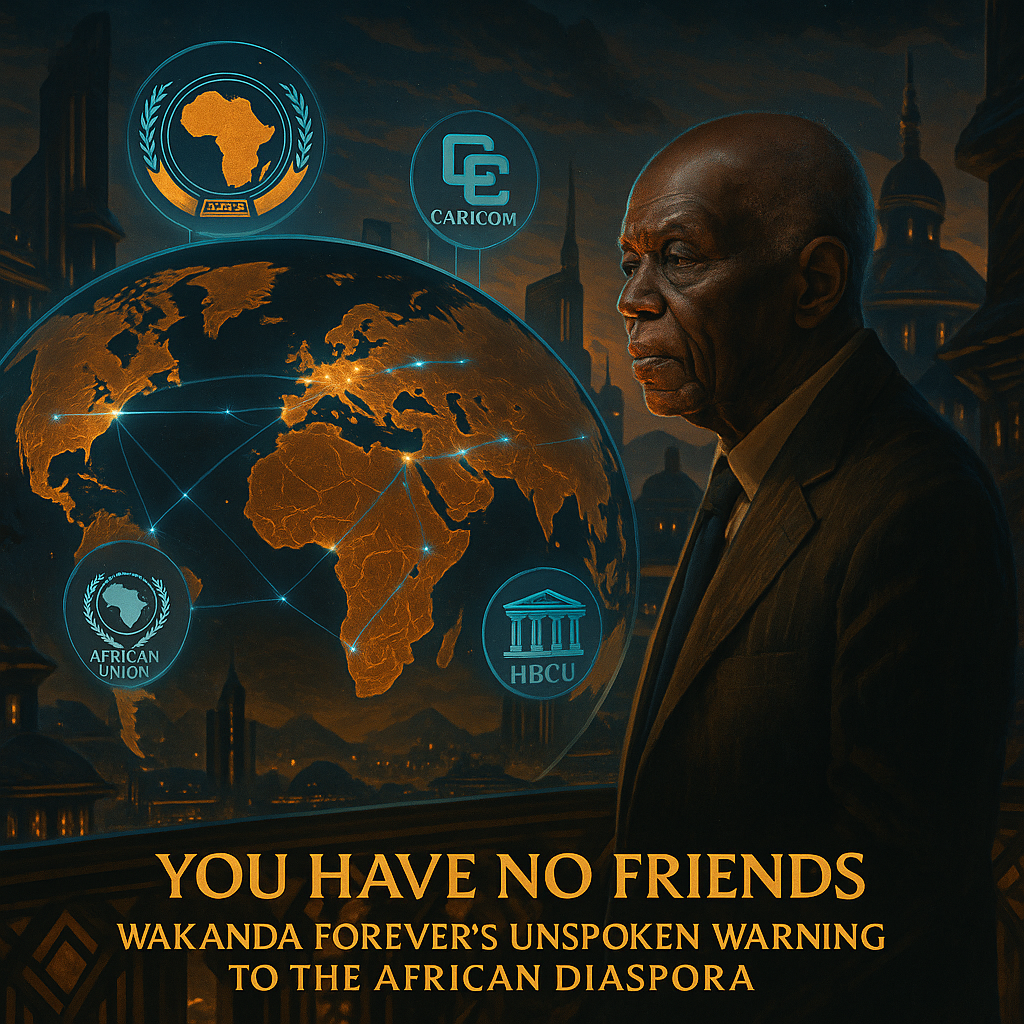
“It is very difficult for people who have been robbed of everything to realize that they have no friends,” Dr. John Henrik Clarke once said, reminding African-descended people around the world that geopolitics is not governed by sympathy, but by self-interest. The iconic African American historian’s words have echoed for decades across lecture halls, study groups, and political forums. Yet their meaning remains elusive for many, who mistake symbolic inclusion for structural alliance and representation for real power. Marvel’s Black Panther: Wakanda Forever didn’t just mourn the loss of a king; it offered a cinematic allegory for the African Diaspora’s precarious position in a world of sharks cloaked in smiles.
Behind its Afrofuturist visuals and emotional tributes lies a chilling parable: even Wakanda, the most powerful Black nation on Earth, cannot afford to trust other nations — even those who appear to share its colonial scars. For the African Diaspora, it’s a sobering mirror: you are not merely competing with the West for survival and sovereignty — you’re competing with everyone. In this age of multipolar power, a new South is rising, and not all its members are friends.
A Moment of Mourning, A Message of Caution
Black Panther: Wakanda Forever opens in mourning — not just for T’Challa, but for the illusion that power and peace can coexist without sacrifice. Shuri, the film’s technocratic princess, and Queen Ramonda, the heartbroken monarch, are forced to confront a global order that smells blood in the water now that Wakanda’s protector is gone.
This scene resonates far beyond the Marvel Cinematic Universe. As African and African-descended nations struggle to build sovereignty — economically, culturally, and militarily — the global system looks at their vulnerability as opportunity. “You have no friends” is no longer just a warning about Europeans. It’s a sobering call to remain vigilant even among fellow colonized nations, fellow Global South leaders, and fellow victims of imperialism.
When Namor, the Mesoamerican-inspired king of the undersea nation Talokan, surfaces to confront Wakanda, he comes not with peace, but with a proposition: join me or be destroyed. The symbolism is unmistakable. The African Diaspora is often told that unity with others who suffered under colonialism is natural and necessary. But Namor doesn’t want unity — he wants Wakanda’s silence, its complicity, and eventually, its submission. Dr. Clarke’s quote reverberates louder than ever: even your neighbors can be rivals when power is at stake.
Dr. John Henrik Clarke: The Prophet of Black Realpolitik
To understand why this message matters, we must return to the man who spoke it first. Dr. John Henrik Clarke was no ordinary historian. He was a Pan-African griot, a meticulous chronicler of African achievement and trauma who dedicated his life to unveiling the lies of Eurocentric history. But he was also a realist. He knew that romanticism was a luxury African people could not afford.
“You have no friends,” Clarke declared not in bitterness but in clarity. His insight came from watching African nations beg for support at the United Nations while newly independent Asian nations brokered economic partnerships. He watched as African Americans marched for civil rights while other ethnic groups negotiated for federal contracts and real estate empires. He saw that Black solidarity, though powerful, was rarely reciprocated.
His words were a mirror and a map — showing the African Diaspora where it stood and where it must go. Not as the moral conscience of the world, but as an emerging power, forced to build alliances with caution and compete like everyone else. Clarke’s warning demands that Black people shed the belief that shared struggle creates permanent allies.
Wakanda’s Real Enemy Was Not Just the West
The brilliance of Wakanda Forever lies in its political subtext. The Western powers, eager to access vibranium, attempt covert attacks and political manipulation. But they are almost cartoonish in their greed. More dangerous is Namor, whose logic is rooted in anti-colonial trauma. He tells Shuri that the surface world is a threat to both Talokan and Wakanda — and yet he positions Wakanda as the buffer, not the partner.
This is not fantasy. In the real world, African and African-descended countries find themselves in similar positions. Brazil, India, and China — rising powers in their own right — seek access to African resources and markets. But their interest is strategic, not fraternal. China offers roads and railways in exchange for minerals. India offers trade deals, but rarely at parity. Brazil is home to the largest Black population outside Africa, yet its Black political class remains marginal.
These are not enemies — but they are not friends. They are competitors. As Wakanda discovered, similarity in struggle does not translate to similarity in strategy. Solidarity, if not paired with shared objectives and clear power boundaries, can become subjugation by another name.
Pan-Africanism Must Be Strategic, Not Sentimental
There is a yearning among the African Diaspora to unite globally. From Ghana’s “Year of Return” campaign to calls for reparations in the Caribbean and the U.S., the idea of one Black global family remains powerful. But power cannot be built on sentiment alone. Pan-Africanism must evolve into a doctrine of strategy, self-interest, and selective partnership.
This means building Black financial institutions that span continents, forming joint security frameworks, and developing media infrastructure that tells our stories on our terms. It means understanding that a Nigerian oil company, a Jamaican fintech startup, or a Black-owned shipping line in Baltimore is just as important to Black sovereignty as marching in protest.
In Wakanda Forever, Shuri only wins by fusing science with spirituality, tradition with innovation. That’s the lesson for Pan-Africanism, too. We must remember the ancestors, but also outthink the competition. We must chant “Ashe,” then write the patent. We must sing the spiritual, then launch the satellite.
The Mirage of Minority Coalitions
A critical aspect of Dr. Clarke’s warning is the tendency of Black people — especially in the U.S. — to believe that all oppressed groups are in natural alliance. The modern liberal coalition in America often includes African Americans, Latinos, Asian Americans, Indigenous groups, LGBTQ communities, and more. But the political economy of these coalitions is rarely equal.
In practice, Black voters are often the loyal base, while other groups leverage their growing numbers into targeted policy wins. Black communities get promises. Others get contracts, land, and legislation.
Even in entertainment, this dynamic persists. Afro-Latino actors are often used to portray “Blackness” without engaging Black American culture. In politics, phrases like “people of color” can obscure the unique legacies of slavery and racial capitalism that shaped African Americans’ reality.
Wakanda Forever alludes to this with subtlety. When Namor tells Shuri that Talokan has remained hidden for centuries, like Wakanda, he also makes clear that he does not view Wakanda as an equal — he views it as a potential pawn. Clarke’s voice echoes again: you have no friends.
The Rise of the Global Black Bourgeoisie
One of the dangers of ignoring Dr. Clarke’s warning is the rise of a complacent Black elite, disconnected from global Black struggle. In the post-George Floyd era, corporations pledged billions for “racial equity.” Elite Black professionals were elevated into C-suites, university boards, and media positions. But these appointments are not sovereignty. They are insulation — often meant to shield institutions from radical change.
Wakanda, for all its cultural pride, nearly falls into this trap. After T’Challa’s death, the temptation to preserve appearances — rather than innovate — almost leads to catastrophe. Only when Shuri fully embraces her power, her rage, and her responsibility does Wakanda stabilize.
The global Black elite must do the same. They must build independent institutions — banks, logistics companies, think tanks, and agricultural networks. It is not enough to be represented in white spaces. We must own Black ones.
Afro-Indigenous Solidarity: Complex, But Not Impossible
Some audiences saw Wakanda Forever as a missed opportunity for Afro-Indigenous solidarity. Talokan, inspired by Mayan and Aztec mythology, represents another oppressed group — colonized by Spain rather than Britain. The idea of Black and Brown people uniting against the West is seductive.
But Clarke’s wisdom urges us to ask: what is the price of that unity? Is it real partnership, or romantic projection? What do our communities know of each other’s history, culture, and goals?
If Afro-Indigenous solidarity is to mean anything, it must be built on mutual power and respect — not shared victimhood. That means intercontinental exchanges between African and Indigenous universities. It means joint ventures in energy and farming. It means cultural diplomacy with substance, not photo ops.
Shuri’s final act of mercy toward Namor is a gesture of peace. But it’s also a declaration of boundaries. She spares him, but she does not join him. That’s the balance Pan-Africanism must strike: compassion without surrender.
What Now? From Clarke to Wakanda, From Theory to Action
Dr. Clarke’s lesson, embodied in Wakanda Forever, must be more than a quote for social media or a plotline in a superhero film. It must be a doctrine. The African Diaspora stands at a global crossroads. Climate change, AI, demographic shifts, and a fractured world order are reshaping who will rule in the 21st century. Africa is the youngest continent. African Americans wield enormous cultural power. Caribbean nations are rethinking currency and sovereignty.
But none of this guarantees power — or safety.
Clarke reminds us: don’t mistake politeness for protection. Don’t confuse presence with power. And don’t ever believe that justice will be handed to you by those who benefit from your exclusion. The African Diaspora has only one path forward — one that is cooperative, yes, but ruthlessly strategic. We must cultivate real allies, build our own arsenals (economic and intellectual), and never forget who we are in a world that profits from our confusion.
If Wakanda has taught us anything, it’s this: survival without sovereignty is still subjugation.
And as Clarke made clear, no one will save us — but us.
Disclaimer: This article was assisted by ChatGPT.
 hbcupolitics