“If you can only be tall because somebody’s on their knees, then you have a serious problem. And white people have a very, very serious problem.” – Toni Morrison
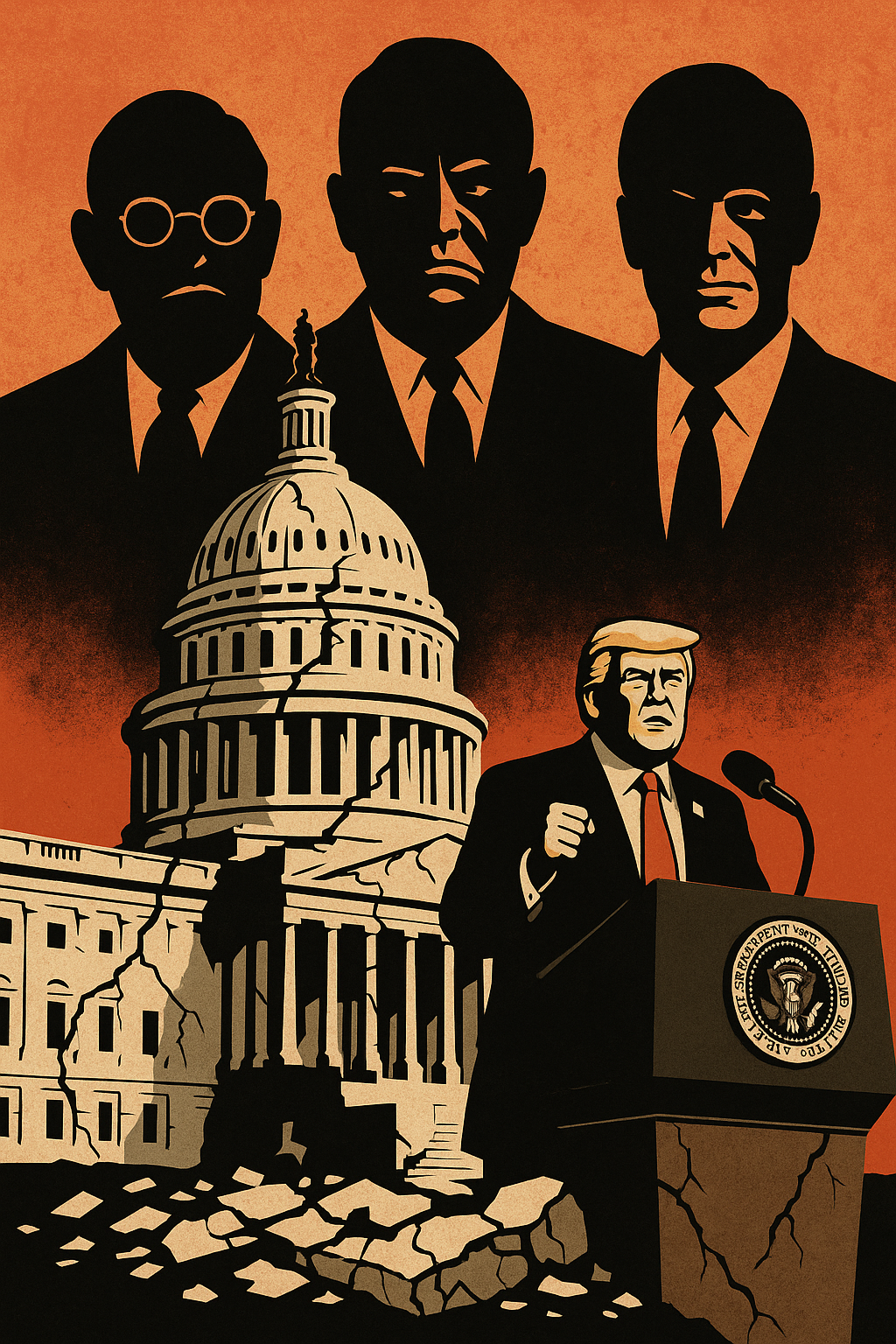
A Dream Deferred… Now Delivered?
In 1963, Alabama Governor George Wallace stood on the steps of the University of Alabama and declared “segregation now, segregation tomorrow, segregation forever.” That same year, Birmingham’s Commissioner of Public Safety, Bull Connor, unleashed fire hoses and dogs on Black children. And for the latter half of the 20th century, David Duke tried to rebrand white supremacy as a suit-and-tie political ideology that could flirt with the Republican mainstream. They were men driven by an unwavering belief in white dominance, fueled by resentment of Black progress, and willing to use state power to preserve America as a white ethnostate.
Now, in 2025, their ideological legacy is poised to take the White House in full. A second Donald Trump presidency—this time unconstrained by reelection pressure or traditional political norms—stands not just as a Republican victory but as a resurrection of America’s most dangerous domestic political tradition: white supremacist governance under the guise of populist nationalism. This isn’t just about Donald Trump. This is about an entire movement now legitimized and emboldened, and it will disproportionately target African American institutions—especially those like HBCUs that signify collective Black advancement.
Trump’s second administration, if realized, is not a policy experiment. It is a cultural retribution. And for Wallace, Connor, and Duke, it’s the completion of a vision where the federal government no longer protects Black America—but punishes it.
From Dog Whistles to Megaphones
There was a time when white supremacy was cloaked in code words: “states’ rights,” “law and order,” and “school choice.” Donald Trump has ripped off the veil. His calls for mass deportations, a federal police force to hunt undocumented immigrants, the execution of drug dealers, and military occupation of cities under the pretense of quelling crime are not simply campaign rhetoric—they are autocratic manifestos with deep racial undertones.
George Wallace once weaponized the language of populism to undermine civil rights legislation. Trump follows suit, exploiting economic anxiety, cultural fear, and racial scapegoating to build a coalition that is less conservative than it is confederate in ethos. The 2024 campaign slogan “Revenge Is Coming” echoes not Ronald Reagan but Reconstruction’s undoing. It is the language of the Red Shirts and the Klan.
Unlike Nixon’s Southern Strategy, Trump’s appeal to white grievance is not subtle—it is performative and proud. He invites convicted insurrectionists to rallies, aligns with Christian nationalism, and openly mocks DEI initiatives and historical reckonings. His 2024 platform, shaped heavily by The Heritage Foundation’s “Project 2025,” outlines a roadmap for dismantling civil rights infrastructure wholesale.
The goal isn’t just rollback—it’s erasure.
The Institutional Extermination Plan
A Trump second term is a direct threat to African American institutional life. His first term already defunded fair housing enforcement, attempted to eliminate Title III HBCU funding (only to backtrack for political optics), and tried to collapse the Civil Rights Division of the Justice Department into bureaucratic irrelevance. But round two? The gloves are off.
Expect the elimination or consolidation of offices like:
- The Office for Civil Rights at the Department of Education
- The Minority Business Development Agency (MBDA)
- The HBCU Initiative at the White House
- Voting Rights Section of DOJ
HBCUs would be especially vulnerable. Federal student aid policies could shift to voucher-based systems that heavily benefit private, white-dominated institutions. Expect crackdowns on “woke curriculum,” and the reintroduction of colorblind policies designed to disadvantage students attending public HBCUs in Republican-controlled states. Already, governors like Ron DeSantis have experimented with removing DEI programs and rewriting Black history in Florida. Trump would federalize such initiatives.
And this time, he’ll have an army of operatives willing to do it.
The Judges, The Generals, The Jackals
George Wallace wanted federal judges who would block desegregation. Trump has already delivered 234 federal judges, three Supreme Court justices, and has pledged to expand the judiciary further with loyalists. His second term would include appointments who view the Civil Rights Act, Voting Rights Act, and affirmative action as unconstitutional infringements on “white rights.”
Under Project 2025, Trump is expected to replace tens of thousands of civil servants with political appointees who are fiercely loyal and ideologically extreme. This includes:
- A Department of Justice run by anti-DEI crusaders
- A Department of Education that views the 1619 Project as treasonous
- A Department of Homeland Security that merges ICE and federal policing into a paramilitary immigration task force
- A Department of Labor that eliminates diversity hiring incentives
Imagine David Duke with control over the hiring, training, and mission of 1.5 million federal workers. Imagine Bull Connor with a Pentagon budget and the ability to deploy troops into “Democrat-run cities.” Imagine George Wallace with access to facial recognition technology, AI surveillance, and mass data harvesting.
That’s not a dystopia. That’s the plan.
The End of Federal Neutrality
One of the most dangerous shifts under a second Trump term is not the obvious racism—it’s the elimination of federal neutrality.
Under Obama, the federal government took symbolic and structural stances in defense of marginalized communities: launching investigations into police departments, supporting Black entrepreneurship, and enforcing anti-discrimination laws. Even under Reagan and Bush, the executive branch at least maintained rhetorical alignment with constitutional equality.
Trump II will use the federal government not as a shield but as a sword—targeting public education, voting, and reproductive rights in explicitly racialized terms. Already, Trump’s allies have said the quiet part out loud: “We will purge the DEI cult,” “We will eliminate critical race theory from government,” and “We will ensure no federal money goes to institutions that teach racial resentment.”
Expect attacks on:
- African American non-profit organizations, labeled a treasonous or reverse racism
- African American studies departments, threatened with federal defunding
- HBCU graduate programs, tied to DEI and threatened with federal discrediting campaigns
It’s not just about dismantling support—it’s about punishing symbols of Black institutional progress.
Strategic Silence from Liberal Institutions
Wallace, Connor, and Duke never acted alone. They depended on the silence of white liberals and centrists who were “disturbed” but not disturbed enough to act. Today’s Democratic elite, academia, and corporate class risk repeating history. Already, major corporations have begun distancing themselves from DEI commitments in fear of political backlash. Philanthropic funding is drying up. Tech companies have defunded diversity pipelines. University boards are replacing equity-minded presidents with apolitical caretakers.
As the temperature rises, white-dominated institutions hedge their bets. They fear populism more than racism.
For Black media, Black financial institutions, HBCUs, and civil rights organizations—there will be no cavalry. The strategic response must be institutional fortification, cross-sector alliances, and aggressive self-funding. Because if Trump returns, every dollar and data point will be weaponized. Census data, voter rolls, federal grant disbursements—all will be mined and manipulated to marginalize.
The Backlash Is the Strategy
Donald Trump is not an aberration—he is a backlash. His political rise coincided with:
- The first Black president
- The emergence of Black Lives Matter
- Rising HBCU enrollments
- Black women being elected to the Senate and Vice Presidency
In white supremacist logic, this is a threat to the racial order. Trump’s power lies in transforming backlash into governing doctrine. From book bans to voter suppression to attacks on birthright citizenship, Trumpism is a blueprint of re-enslavement through bureaucratic and legal design.
George Wallace hoped for a Dixiecrat nation. Bull Connor enforced it violently. David Duke wanted it legitimized through electoral success. Trump promises to do all three.
African American Institutions as Resistance Fortresses
In this era of institutional warfare, African American institutions—from HBCUs to Black media outlets, credit unions, and advocacy organizations—must evolve beyond their traditional missions. They must become fortresses of resistance, innovation, and self-preservation.
This moment demands that African American institutions no longer serve only as havens for service—but as engines of strategic confrontation. The battleground is no longer only economic or electoral. It is epistemological, technological, and structural.
Political Education: Educational institutions must train students and communities not just for employment, but for ideological warfare. Understanding policy, propaganda, history, and resistance strategy must be central to all Black civic training.
Institutional Capital: Financial institutions must scale. Foundations must fund long-term projects. Every dollar is a shield—and a sword.
HBCU Police Departments Need To Form Racial Terrorism Intelligence Units
Cross-Institutional Alliances: Professional organizations, HBCUs, advocacy groups, and civic organizations must build permanent, binding alliances that transcend ego or scandal. From collective litigation to pooled lobbying, African American institutions must unite across geography and generation.
Cyber Defense: As attacks move from the courtroom to the cloud, data sovereignty becomes existential. Institutions must invest in cybersecurity, own their tech infrastructure, and train Black cyberdefenders.
Media Ownership: African American institutions must reclaim the authority to tell their own stories. That means resourcing Black-owned newspapers, launching digital platforms, and building communications arms within every institution.
This is not merely a struggle for survival. It is a fight for intellectual and cultural sovereignty—for the right to think, organize, and self-determine outside of a political system increasingly hostile to Black advancement.
“The South Will Rise Again”—But This Time It’s National
George Wallace once said, “The only way to stop integration is with a club in your hand.” Donald Trump has replaced the club with an executive order. Bull Connor needed fire hoses. Trump has facial recognition and drone surveillance. David Duke needed dog whistles. Trump tweets it in all caps.
We are not entering an age of ignorance—we are entering an age of informed white supremacy. One that reads think tanks, drafts legislation, and wears the Constitution like a costume. It does not want your compliance. It wants your extinction.
And unless African America prepares now, with institutional power, capital readiness, and relentless clarity—then the second Trump administration will not just undo progress. It will fulfill a 60-year-old dream deferred.
One in which Wallace, Connor, and Duke finally get what they always wanted:
Total control.
Disclaimer: This article was assisted by ChatGPT.
 hbcupolitics