“For every action, there is an equal or greater reaction.”
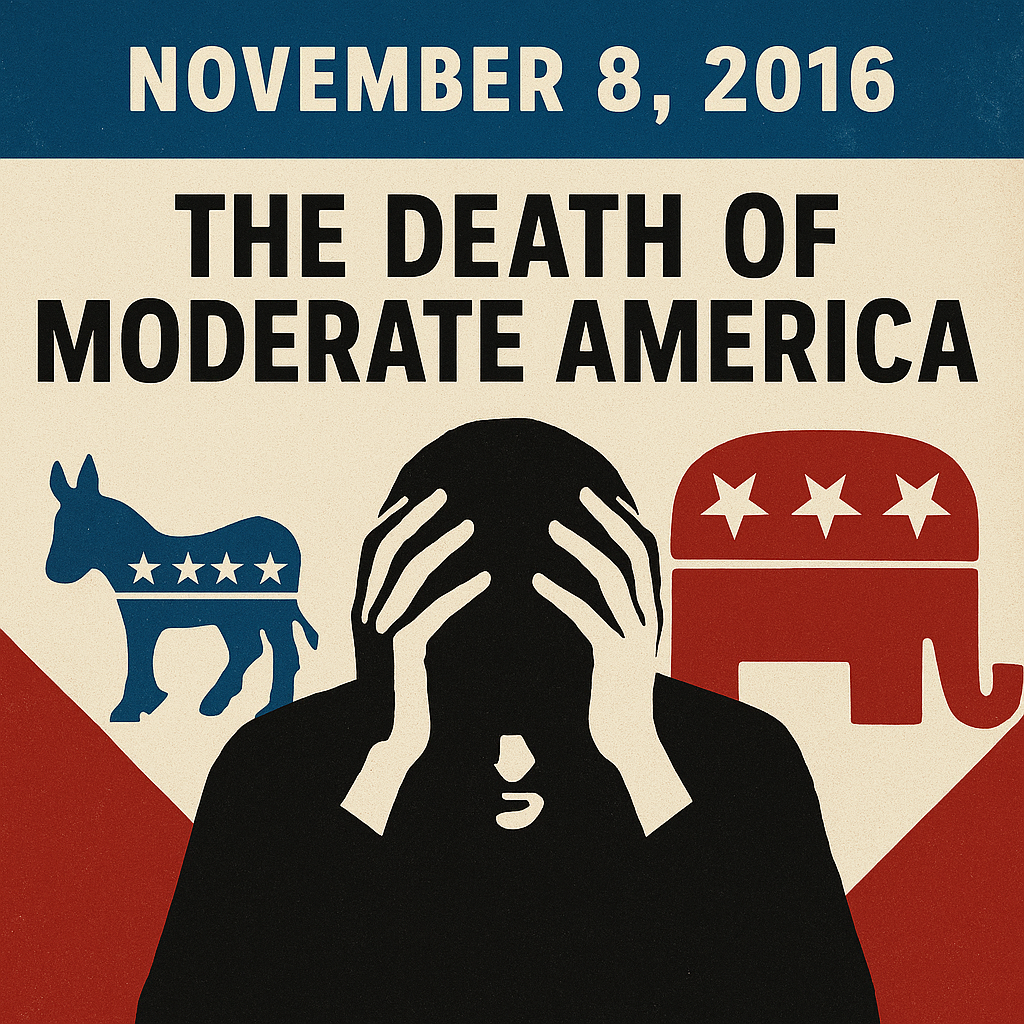
At its core, the demographics of America still make it a culturally European dominated country. And the response with the latest election in the United is as much an echo from what happen in the British Exit from the EU also known as #Brexit, largely based on immigration and rapidly shifting demographics, as anything else pundits may try to use to explain Trump’s victory. But what it also tells us is the country and maybe the world’s political temperature continues to move toward the fringes.
Eight years ago, two things happen on November 4, 2008. One, Senator Barack Obama became president-elect and secondly, moderate America went into a coma. Eight years later, America finally pulled the plug.
You could see the writing on the wall over the past eight years as moderates in both parties began to suffer defeat after defeat. Moderate Republicans were ousted in favor of Tea Party candidates and conservative Democrats became harder to find your car in a New England blizzard. During the presidential primaries the country was indeed ready to say goodbye to its moderate family member. In a crowded Republican field of sixteen at one point, arose a silver-spooned unpolished and outsider, Donald Trump. On the Democrat side, the de facto incumbent, Hillary Clinton, the party’s “sure” thing found herself in a dog fight with a silver-haired outlandish and outsider, Bernie Sanders. It took everything in her arsenal (and the party’s) to seemingly drag her to the party’s nomination.
Hillary Clinton’s real downfall was that she was too centric to exist in this populist climate. Rural whites wanted their country back and Millenials wanted someone who was going to give them a political revolution that dragged corporate interest as they perceive it to the guillotines. The Democrats and Republican parties actually both underestimated just how far the populist movement in the country had infiltrated the psyche, but this election has shown both of them the light and if the Democrats plan to put forth a viable candidate in four years against the incumbent, then that person will need to be in the ilk of Bernie Sanders and not Hillary Clinton. Potentially, a leftist version that exceeds even Donald Trump. But has it really come to that? Why is a country that claims 42 percent of its votership is independent not have a more moderate political climate?

Well, for starters there should be no confusion that just because one is an independent voter, that they are also moderate in their politics. Despite, according the Washington Post, party identification being at all-time lows (see graph), a good deal of the segment of voters does see itself as staunchly conservative or liberal even without party affiliation.
The Erosion of the Political Middle
Moderate America wasn’t just defeated in 2016—it was systematically dismantled. In the years leading up to Trump’s victory, polarization had already grown to historic proportions. According to Pew Research Center, the average Republican and Democrat were more ideologically distant in 2014 than at any point in the previous two decades. Social media accelerated this divide. What once were barroom debates or family dinner arguments are now algorithmically reinforced echo chambers. Political centrism, already a fragile coalition of consensus-seekers, had no memes, no armies, and no insurgents willing to storm primaries for it. Moderates were fighting guerrilla politics with powdered wigs.
The moderate used to be the broker, the compromiser, the adult in the room. But in a world increasingly defined by “likes,” “shares,” and “cancels,” nuance has become weakness. Centrism started to look like indecision, and bipartisanship began to resemble betrayal. In this new landscape, being a moderate was not just unfashionable—it was suicidal.
Populism: Right and Left
Donald Trump and Bernie Sanders are mirror images of the same political phenomenon: the hollowing out of institutional trust. Whether Wall Street or Washington, the “establishment” was the common enemy. Trump promised to “drain the swamp.” Sanders promised to burn the swamp to the ground and redistribute the ashes.
What 2016 revealed was that populism was no longer fringe—it was mainstream. And not just in America. Look across the Atlantic: in France, Marine Le Pen’s far-right National Front gained momentum. In Germany, the AfD (Alternative für Deutschland) captured seats for the first time. In the Philippines, Rodrigo Duterte ran a campaign so populist and violent it made Trump’s look like a garden party. The same story played out again and again: anger, disenfranchisement, nationalism.
The reason? Populism is a vaccine to moderate complacency. People didn’t want a system that could be tinkered with—they wanted a new system. And moderates, by definition, are system-preservers.
Race, Class, and The Reaction to Obama
If Obama’s election was America’s first black president breaking a glass ceiling, Trump’s was the political equivalent of white America slamming the door behind him. There is no need to rehash birtherism or racial dog whistles—those were clear. But less appreciated is how Obama’s presidency shifted the Overton window so dramatically that reaction was inevitable.
This wasn’t just about race—it was about hierarchy. The conservative working class, especially rural whites, felt pushed to the periphery by cultural globalization, economic outsourcing, and demographic forecasts that said they would soon be a minority. Whether these trends were real or exaggerated by media echo chambers mattered less than the fact that the fear felt real. That fear—of being culturally irrelevant, economically displaced, and politically abandoned—gave populism its gasoline.
Moderates tried to calm the waters. But you can’t appeal to reason when the room is on fire.
The Media’s Role in Polarization
Twenty years ago, most Americans got their news from the same three networks and their local newspaper. Today, media is siloed. Fox News doesn’t just report the news—it constructs a universe. MSNBC does the same from the other side. Throw in YouTube, TikTok, podcasts, Twitter, and Substack, and you’ve got an information ecosystem where truth is less important than alignment.
This fragmentation means there is no longer a shared reality upon which a moderate consensus can be built. Why find common ground when everyone believes they are standing on their own hill of truth?
Worse still, outrage sells. Clicks convert to advertising dollars. Cable segments are no longer about informing—they’re about confirming. Moderates are boring. They don’t go viral. They don’t yell. They don’t promise to lock people up. They don’t burn down Wall Street.
So, the center shrinks. And nobody mourns it—because nobody watches it.
Structural Extremism
Let’s be clear: the American political system rewards extremism. Gerrymandering creates safe districts that encourage candidates to run harder left or right in order to win primaries. Closed primaries prevent independents and moderates from having a say. Super PACs amplify the voices of billionaires with partisan agendas. And voter suppression laws often target communities least likely to vote in lockstep.
If you are a moderate candidate in 2024, your biggest challenge isn’t just winning voters—it’s surviving the system. You’ll be out-funded, out-hyped, and out-meme’d. You are running uphill, backwards, in a snowstorm. And if you dare reach across the aisle, you’ll be accused of weakness or treason—sometimes by your own party.
The very architecture of modern American democracy was not built to house a robust center. It was built to elect whoever screams loudest with the right coalition behind them.
The Illusion of the “Silent Majority”
Every cycle, candidates invoke the so-called “silent majority.” Nixon made it famous. Reagan made it patriotic. Trump made it angry.
But what if the silent majority is no longer moderate? What if silence is just a sign of exhaustion, not neutrality? Many voters are not undecided—they’re uninspired. They don’t vote because they don’t believe in the center. Not because they are extremists, but because they have seen the center promise change and deliver none.
When working-class wages stagnated, moderate leaders said, “Give it time.” When Black communities cried out about police brutality, moderates said, “Let’s review the data.” When millennials drowned in student debt, the center responded with “means-tested reform.”
It’s not that the center stopped offering solutions. It’s that the solutions felt insufficient. Moderation, once the virtue of wisdom, now feels like the cousin of cowardice.
What Comes Next?
With Trump’s election, America didn’t just vote for a man—it voted for a posture. And that posture was defiance. Against elites. Against institutions. Against the press. Against the past eight years.
Can moderate America come back? Maybe. But not in the same form.
The new moderate, if they are to be reborn, must be bold in thought but tempered in tone. They must acknowledge pain, not paper over it. They must offer reform, not rhetoric. And they must inspire—not manage—hope.
The next Barack Obama won’t be a unifier just because he can give a good speech. He will have to build coalitions that can survive fire. The next John McCain won’t be admired just for reaching across the aisle—he will have to fight for the center like it’s a revolution.
Because in today’s America, it is.
A Closing Requiem for the Center
November 8, 2016, was not just a presidential election. It was a referendum on how much Americans trusted the system. The verdict was clear.
Moderate America had its time. It gave us Medicare and Social Security. It guided civil rights legislation. It managed the Cold War and deregulated the markets. It negotiated. It triangulated. It kept the ship afloat.
But now the tides have changed.
Moderation didn’t die because it was wrong. It died because it no longer had an audience.
And unless something shifts—unless there’s a new generation of Americans willing to fight for compromise as fiercely as others fight for power—it may not rise again.
Disclaimer: This article was assisted by ChatGPT.
 hbcupolitics