“The higher you go, the fewer women there are. So each time you see a woman in a position of leadership, you have to support her. It’s not just her achievement, it’s an achievement for all of us.” – Wangari Maathai
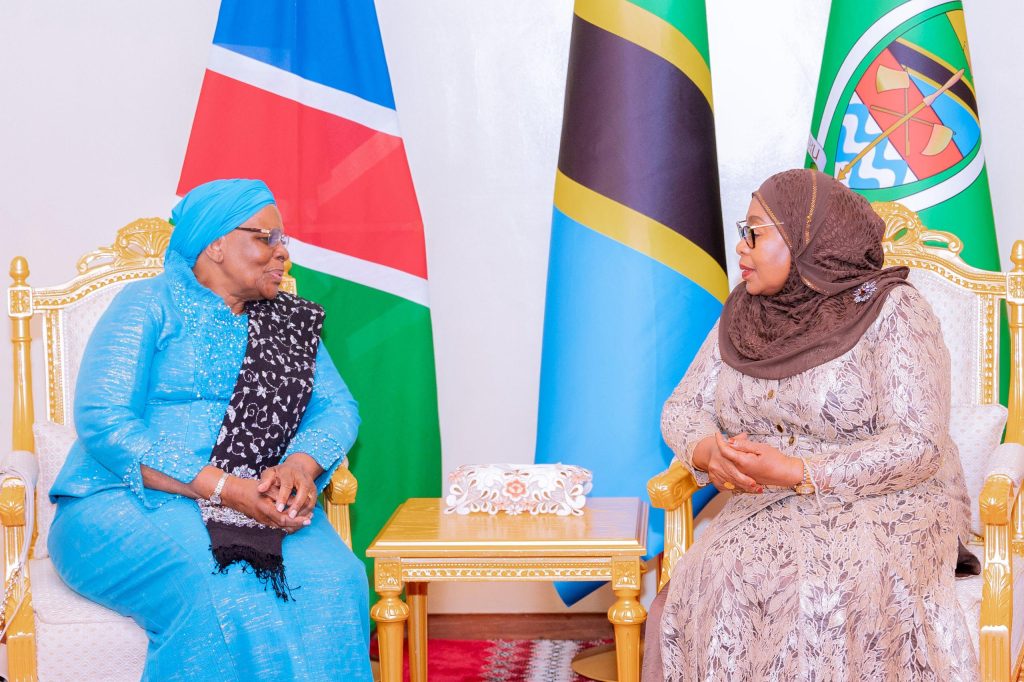
In an era marked by global democratic regression and resurgent authoritarianism, the leadership examples of President Samia Suluhu Hassan of Tanzania and President Netumbo Nandi-Ndaitwah of Namibia offer a compelling counter-narrative: one grounded in pragmatism, continuity, and soft power wielded with precision. As African American women face entrenched structural barriers in U.S. politics—ranging from underrepresentation to cultural tokenism—these two African women heads of state provide a strategic template worth studying and adapting.
This is not to imply that the conditions of Tanzania, Namibia, and the United States are parallel. But in the realm of political capital, optics, coalition-building, and strategic patience, the transnational lessons are clear: leadership rooted in a firm sense of identity, backed by institutional maneuvering and an unapologetic commitment to inclusive governance, can yield transformational power.
The African Context, American Relevance
President Samia Suluhu Hassan became Tanzania’s sixth president in 2021, ascending after the sudden death of her predecessor, John Magufuli. As the first woman to hold the office in the nation’s history—and a hijab-wearing Muslim woman from the semi-autonomous region of Zanzibar—her rise signaled more than a constitutional succession. It challenged deep gendered, regional, and religious assumptions about political leadership on the continent.
In contrast, President Netumbo Nandi-Ndaitwah emerged through Namibia’s post-liberation political architecture. After decades as a diplomat, freedom fighter, and foreign minister, she won her party’s nomination and will now lead the country through its next chapter. While Hassan inherited her presidency, Nandi-Ndaitwah earned hers through rigorous internal politicking and public legitimacy.
For African American women in U.S. politics—whether mayors of major cities like Karen Bass or rising stars in Congress like Lauren Underwood—the leadership of Hassan and Nandi-Ndaitwah offers critical insights: not only in achieving power, but in deploying it.
Identity is a Strategic Asset—Not a Liability
In Western political systems, African American women are often forced to dilute their identities to gain viability. The expectation is to be everything for everyone: assertive but not aggressive, qualified but not too ambitious, relatable but not radical.
Hassan and Nandi-Ndaitwah took a different approach. Rather than disavow their identities, they made them the foundation of their political legitimacy.
President Hassan’s 2021 inauguration speech sent a message both to the Tanzanian elite and international observers: “The one standing here is the President of the United Republic whose biological status is that of a woman.” In that moment, she reframed gender not as a weakness to be overcome but as a lens through which she would govern differently—and arguably more inclusively.
Similarly, Nandi-Ndaitwah’s liberation credentials—from fighting in SWAPO’s independence struggle to shaping Namibia’s foreign policy—are integral to her authority. Her political identity is tied to decades of service, gender equity, and nation-building.
For African American women leaders, this suggests a shift in the power frame. Identity need not be a burden. When rooted in authenticity and historical legitimacy, it becomes a political instrument.
Soft Power Over Hard Clashes
Both Hassan and Nandi-Ndaitwah rose in systems dominated by patriarchal party structures and, at times, heavy-handed political orthodoxy. But neither approached leadership through confrontation. Instead, they wielded what Joseph Nye termed “soft power”: the ability to shape preferences through appeal, persuasion, and diplomacy.
When Hassan assumed office, she inherited a deeply polarized Tanzania. The late President Magufuli had cracked down on opposition and civil society, leaving a trail of democratic decay. Rather than instigate an abrupt reversal, Hassan adopted the language of the “4Rs”: Reconciliation, Resilience, Reforms, and Rebuilding.
By lifting bans on political rallies, reopening shuttered media houses, and meeting with opposition leaders, she reframed the state’s posture—without alienating the Magufuli loyalist base. This balancing act allowed her to quietly consolidate power, neutralize adversaries, and open the political space.
Nandi-Ndaitwah has been equally strategic. While her tenure as foreign minister could have remained bureaucratic, she used it as a platform to project Namibia’s global interests while reinforcing her domestic viability. Her ascension to the presidency was not through disruptive insurgency but meticulous coalition-building within SWAPO.
Contrast this with the American experience, where African American women leaders are often expected to take “activist” roles—loud, confrontational, and relegated to the moral margins. The Tanzanian and Namibian models show that soft power—calibrated, principled, and strategic—can yield structural transformation with less backlash and greater longevity.
The Institutional Pathway: Patience Over Performance
In U.S. politics, African American women often have to demonstrate immediate results to be deemed successful—a paradox of performance. Yet both Hassan and Nandi-Ndaitwah show that leadership does not always begin with the presidency. It requires institutional patience and lateral mobility.
Before becoming president, Hassan served in multiple political roles: as a regional commissioner, a minister, a parliamentarian, and ultimately, the vice president. Each stage built her bureaucratic skillset, widened her network, and—crucially—normalized her presence in the male-dominated political apparatus.
Nandi-Ndaitwah’s path was even more layered. Her experience spans diplomacy, liberation struggle, legislative work, and ministerial leadership. By the time she announced her candidacy, her political résumé read more like a constitutional roadmap than a résumé booster.
In the U.S., African American women often face a double-edged sword: under scrutiny at the local level (as in the cases of former Baltimore mayor Catherine Pugh or former Atlanta mayor Keisha Lance Bottoms), and yet rarely given the platform to transition into national executive roles. The African examples suggest that building durable political capital—over decades, not election cycles—may be more important than viral soundbites or symbolic appointments.
Political Inclusion Requires Policy Equity
One of the most notable achievements of President Nandi-Ndaitwah’s early cabinet formation was her decision to appoint a women-majority Cabinet—making Namibia the first African country to do so. This was not just symbolic. It reoriented national governance toward equity and competence.
Similarly, Hassan’s early governance reforms included balancing the cabinet, inviting dialogue across opposition lines, and reinforcing women leadership in key ministries. Even as she walks a tightrope between reformist expectations and ruling-party conservatism, the message is clear: inclusion is not charity. It’s central to state legitimacy.
African American women politicians—who disproportionately shoulder the “equity” mantle in the U.S.—often face the challenge of being the only rather than among many. These African heads of state illustrate how structural inclusion is a choice of governance, not just of optics.
Diplomacy as Domestic Leverage
In her tenure, Hassan has not only repositioned Tanzania in global investment conversations but has also used international diplomacy to buffer domestic reforms. By engaging with global health initiatives, environmental forums, and foreign investors, she has diversified Tanzania’s geopolitical alliances while signaling a return to multilateralism.
For African American women, especially those in federal roles, international engagement can offer two-fold returns: global positioning and domestic credibility. Former U.N. Ambassador Susan Rice and Vice President Kamala Harris, in her limited diplomatic outings, have each faced criticism for not translating global engagement into domestic political capital. But as Hassan and Nandi-Ndaitwah demonstrate, diplomacy should not be an afterthought. It is governance—on the world stage.
Managing Criticism with Calculated Response
Despite their successes, neither Hassan nor Nandi-Ndaitwah is above reproach. Hassan has faced criticism over slow democratic reforms, perceived backsliding in freedom of assembly, and controversial internet and media laws. Civil society in Tanzania remains cautious, if not skeptical, of her reformist bonafides.
Nandi-Ndaitwah, on the other hand, enters office with the burden of SWAPO’s declining popularity amid economic stagnation and youth unemployment. As a product of the liberation movement, she must navigate a generational shift in expectations while stabilizing the party’s waning grip.
Both leaders offer a lesson in how to absorb criticism without implosion: by acknowledging challenges, making incremental reforms, and framing backlash as part of the democratic process.
In the U.S., African American women are often the first to be scapegoated in times of crisis. Whether it’s school boards, mayoralties, or congressional committees, criticism can become character assassination. But these African leaders show that survival lies not in silence or apology—but in recalibrating strategy while holding power.
The Long Game
African American women in U.S. politics operate under extraordinary constraints. They must campaign harder, fundraise more creatively, and build coalitions that extend across gender, race, and class—often without the safety net of dynastic privilege or inherited political machinery.
Yet, in looking across the Atlantic, a blueprint emerges. Not a copy-paste formula, but a paradigm: build credibility within institutions; reframe identity as a political asset; lead with policy, not personality; and recognize that soft power, used wisely, is a tool of survival and expansion.
Presidents Samia Suluhu Hassan and Netumbo Nandi-Ndaitwah have shown that it is possible to lead as women, as reformers, and as national symbols without yielding to the traps of tokenism or political martyrdom. Their leadership offers a potent reminder to African American women: power is not seized in a moment—it is accumulated, refined, and sustained over time.
In the long game of politics, it is not just about breaking ceilings. It’s about reinforcing the walls, securing the floor, and owning the entire house.
 hbcupolitics